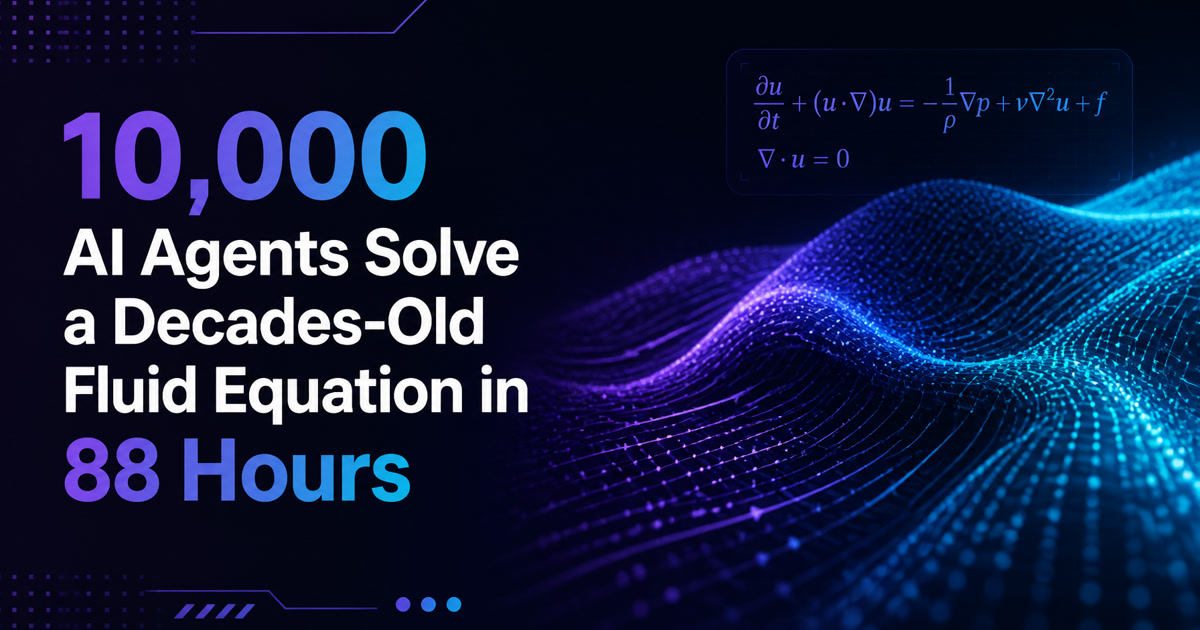
TL;DR: OpenAI says 10,000 autonomous agents running on an unreleased internal model found a “singularity” in the three-dimensional Navier-Stokes equations — resolving one of the six remaining Millennium Prize Problems — in 88 hours. The agents exchanged roughly 3 million messages on Navier-Stokes alone, and a second model spent 17 more hours formalizing the proof in Lean. The result has already triggered a priority dispute with NYU’s Tristan Buckmaster and Anthropic’s Levent Alpöge.
Why this problem matters
Navier-Stokes is not obscure. Written down in the mid-19th century, the equations govern how fluids flow — ocean currents, air over a wing, blood through arteries. Yet one question resisted proof for 90 years: can their solutions “blow up,” developing a singularity where some infinitesimal region of fluid spins infinitely fast in finite time? In 2000 the Clay Mathematics Institute named it one of seven Millennium Prize Problems, each carrying a $1 million bounty (Source: Quanta Magazine — AI Has Solved One of Math’s $1 Million Millennium Prize Problems).
On Tuesday, September 8, OpenAI announced that its agents had found exactly such a singularity in three dimensions, with the result formally checked in the Lean proof assistant (Source: OpenAI — Solving the Navier-Stokes equations).
10,000 agents, 88 hours, one result
The scale is the story. OpenAI launched the swarm after hearing, by its own account on September 1, “rumours that two Millennium Prize problems had been resolved,” and pointed its agents at the rest (Source: BBC News — OpenAI says it cracked 90-year-old maths problem in 88 hours). By September 5, 88 hours later, the Navier-Stokes existence-and-smoothness problem had fallen.
The resource footprint is remarkable for a theorem: nearly 3 million messages and 130 billion output tokens on Navier-Stokes alone, and almost 5 million messages across the full effort, including a preliminary run that disproved regularity for the Euler equations (Source: BBC News; Quanta Magazine). OpenAI researcher Sébastien Bubeck put the cost at “several million dollars,” while BBC News estimated roughly $10 million at public API prices (Source: Quanta Magazine; BBC News). The result resolves two of the four statements the prize demands, and OpenAI says it does not intend to claim the money (Source: BBC News).
A controversy over credit and timing
The announcement landed 12 hours after Buckmaster and Alpöge published closely related results, which they reached with help from several models including OpenAI’s Codex (Source: Quanta Magazine). Buckmaster alleges that “information about our progress had been passed to OpenAI” on September 3, and that OpenAI only began its own run afterward. OpenAI disputes this, congratulating the “concurrent work” while insisting it had not seen their work “through any means until they released it publicly” (Source: BBC News).
Both camps stand on the same foundation. The attack strategy descends from Diego Córdoba of Madrid and his former student Luis Martínez-Zoroa, whose “infinite cascade” technique built solutions layer by layer without leaning on computers (Source: Quanta Magazine). Princeton’s Charles Fefferman, who wrote the Clay Institute’s problem description, called them “the heroes of the story,” and Buckmaster said Martínez-Zoroa “deserves a Fields Medal.”
What this actually means
For the physical world, the result is more surprising than useful: real fluids are made of molecules, not infinitely smooth mathematics, so the singularity is an idealization. It tells us turbulence is “even weirder than it appears” (Source: Quanta Magazine).
For AI, it is a landmark in multi-agent reasoning. Ten thousand agents coordinating over millions of messages, with a second model independently verifying the proof in Lean, is a different category from a single model answering a prompt. It extends the trajectory of OpenAI’s GPT-6 Astra flagship and always-on Codex agent, following the lab’s earlier Astra run that formalized ten math problems in Lean. The open question is whether this scales, or is a multimillion-dollar one-off that produced a theorem a small human team was already converging on.
FAQ
Did OpenAI solve a Millennium Prize Problem?
Partially. The agents found a singularity in the 3D Navier-Stokes equations and formalized the proof in Lean, resolving two of four required statements. OpenAI says it won’t claim the $1 million.
How much compute did it take?
No exact figure was disclosed, but Sébastien Bubeck estimated “several million dollars,” and BBC News put it near $10 million based on 130 billion output tokens at public API prices.
Was the result independently verified?
It was formally checked in Lean, giving mathematicians high confidence in correctness, but it hasn’t completed the Clay Institute’s independent verification.
What is the dispute with Buckmaster and Alpöge?
The NYU/Anthropic duo had been working on the same problem using models including OpenAI’s Codex; Buckmaster alleges details of their progress reached OpenAI before the company’s run. OpenAI disputes the timeline and says the proofs differ significantly.
Does this mean real fluids can blow up?
No. The singularity exists only in an idealized model assuming a perfectly smooth, infinitely divisible fluid. Real fluids are molecular, so the result refines our understanding of turbulence, not engineering practice.
Further Reading
- OpenAI — Solving the Navier-Stokes equations
- Quanta Magazine — AI Has Solved One of Math’s $1 Million Millennium Prize Problems
- BBC News — OpenAI says it cracked 90-year-old maths problem in 88 hours
- Clay Mathematics Institute — Navier-Stokes Equation
— The Agent Report