TL;DR
Google’s Deep Think reasoning mode now leads the frontier across reasoning, mathematics, and coding simultaneously — a pattern the benchmark wars haven’t seen in months. On ARC-AGI-2, the abstract-reasoning benchmark verified by the ARC Prize Foundation, Gemini 3.1 Deep Think scores 84.6% against 68.8% for Claude Opus 4.6 and 52.9% for GPT-5.2. Its Codeforces Elo of 3455 and an 81.5% on IMO 2025 problems point to the same conclusion from different angles: the lead isn’t coming from scale, it’s coming from a different inference-time mechanism.
Introduction
For most of 2026, the frontier labs have fought the benchmark war on margin. A point here on GPQA, a new math record there — incremental, contested, quickly reclaimed. Deep Think breaks that rhythm because it wins across categories at the same time.
Deep Think is Google DeepMind’s reasoning mode, first shipped in earnest with Gemini 2.5 in June and refined into Gemini 3.1 Deep Think. The official benchmark table tells a consistent story: it is not merely competitive with Anthropic’s Opus 4.6 and OpenAI’s GPT-5.2, it is ahead of them on nearly every hard, tool-free test that measures genuine reasoning rather than retrieval (Source: Google DeepMind — Gemini 3.1 Deep Think).
The more interesting question is how. The answer appears to be architectural rather than scalar.
The Numbers, In One Pass
The DeepMind performance table is unusually transparent, and worth reading as a whole rather than cherry-picked:
- ARC-AGI-2 (abstract reasoning, ARC Prize verified): Gemini 3.1 Deep Think 84.6%, vs Opus 4.6 Thinking at 68.8% and GPT-5.2 Thinking at 52.9%. Humans average around 60% on this benchmark, which is explicitly designed to resist brute-force pattern matching.
- Codeforces (competitive programming, Elo, no tools): 3455 for Deep Think, against 2512 for Gemini 3 Pro and 2352 for Opus 4.6.
- IMO 2025 (International Math Olympiad): 81.5% for Deep Think, versus 14.3% for Gemini 3 Pro and 71.4% for GPT-5.2 — a 67-point gap over Google’s own non-reasoning model.
- Humanity’s Last Exam (academic reasoning, no tools): 48.4%, ahead of Opus 4.6 (40.0%) and GPT-5.2 (34.5%).
- Physics Olympiad 2025: 87.7%; Chemistry Olympiad: 82.8%; MMMU-Pro: 81.5%.
The IMO number deserves emphasis. A 67-point delta between Deep Think and Gemini 3 Pro on the same underlying model is not a scaling artifact — it’s what happens when you change how the model reasons at inference time. And an advanced research variant of Deep Think has reached gold-medal standard at the IMO, a target that was until recently considered years away (Source: FAQ — Google’s Gemini 2.5 Deep Think Claims the Top of Science, Math, and Reasoning).
It’s Not “Slower Gemini With More Compute”
The temptation is to dismiss reasoning modes as the same model running longer. Deep Think’s own description pushes against that framing.
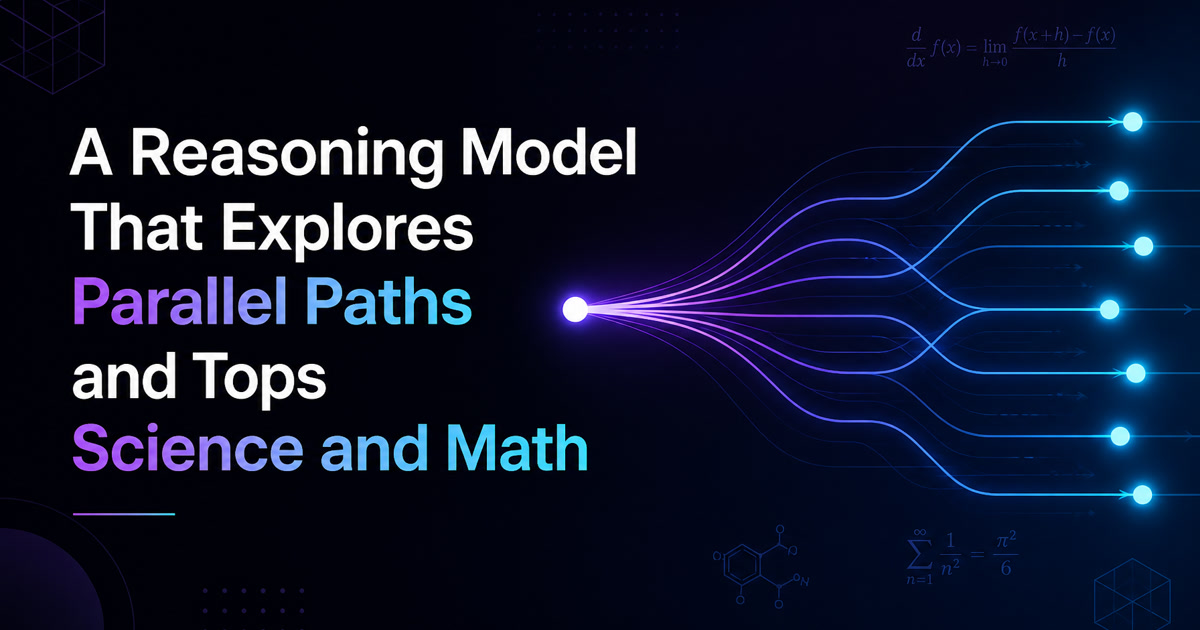
When activated, the model generates multiple chains of thought simultaneously — exploring different solution paths in parallel before converging on a final answer, with novel reinforcement-learning techniques that improve its step-by-step solving over time. The June Gemini 2.5 Deep Think release made the same point explicitly: extended, parallel inference at the moment of answering, not just more tokens of the same reasoning.
This matters because it changes the nature of the gains. A model that just “thinks longer” is still committed to whatever path it started down. Parallel search means the model can hedge — a dead-end branch doesn’t doom the answer the way it does in a single sequential chain. That’s a meaningful qualitative difference, and it’s likely why the wins cluster in the hardest categories: olympiad math, abstract reasoning, and frontier coding, where the value of exploring alternatives is highest.
What It Means for the Field
Three implications stand out.
First, the reasoning lead is now contestable without a bigger base model. Deep Think’s dominance on IMO and Codeforces relative to Gemini 3 Pro shows that inference-time architecture can buy more than the next order of magnitude of parameters. For labs without Google’s training budget, that’s a strategically important signal.
Second, benchmarks are bifurcating into “raw” and “reasoned” tiers. The gap between Deep Think and Gemini 3 Pro on IMO (81.5% vs 14.3%) is so large that publishing a single model number is becoming misleading. The frontier conversation increasingly needs to specify which mode produced which score — a governance and marketing problem as much as a technical one.
Third, the consumer version is a deliberate tradeoff. The Deep Think variant in the Gemini app operates at roughly bronze-medal IMO level — remarkable in its own right — while the gold-medal capability lives in a slower research version. Google is, in effect, selling reasoning as a tiered product with compute as the dial. That’s the clearest signal yet that the economic model for frontier AI is converging on metered thinking.
The Caveats
None of this is uncontested. Reasoning benchmarks — ARC-AGI-2 especially — are a young and moving target, and a score verified by the ARC Prize Foundation is still a snapshot of a single capability, not general intelligence. The absolute ceiling is also shifting: ARC-AGI-3, launched in March 2026 as the new frontier, currently sits at fractions of a percent for even the best models — including Gemini 3.1 Pro at 0.37%.
The honest read is that Deep Think has won a round, not the war. But the round it won is the one that matters most right now: it demonstrated that the next big gains in reasoning are available at inference time, through architecture, for anyone willing to pay the compute bill.
FAQ
What is Deep Think? Google DeepMind’s reasoning mode for Gemini that generates multiple chains of thought in parallel and converges on an answer, rather than following a single sequential reasoning path.
How does it compare on ARC-AGI-2? Gemini 3.1 Deep Think scores 84.6%, versus 68.8% for Claude Opus 4.6 and 52.9% for GPT-5.2 — all ARC Prize-verified, against a ~60% human baseline.
Is it just the same model running longer? No. The parallel-search architecture is a qualitative change — dead-end branches don’t doom an answer the way they do in a single chain of thought.
Why does the IMO gap matter? Deep Think scores 81.5% on IMO 2025 versus 14.3% for Gemini 3 Pro on the same base model — proof that the gains come from the reasoning architecture, not parameter scaling.
Is this the end of the benchmark race? No. ARC-AGI-3 is the new frontier and best models score under 1% on it. Deep Think won a round, not the war.
Further Reading
- Google DeepMind — Gemini 3.1 Deep Think
- FAQ — Google’s Gemini 2.5 Deep Think Claims the Top of Science, Math, and Reasoning
- Digital Applied — Gemini 3 Deep Think: Reasoning Benchmarks & Guide
- Presenc AI — ARC-AGI Frontier Benchmark Tracker 2026
— The Agent Report