TL;DR
- At Gemini at Work 2026 on 8 October, Google Cloud collapsed its enterprise AI products into one Gemini agent covering knowledge work, content and coding. (Source : Google Cloud Blog — Welcome to Gemini at Work 2026)
- The pitch is governance, not capability: cryptographically attested agent identities, policy enforced once across surfaces, and audit logs attributed to the agent. (Source : Google — Google Cloud introduces the Gemini agent for enterprises)
- Spend caps are real but coarse. They pause an entire project, not a single agent. (Source : Google Cloud Docs — Overview of overages and spend controls)
- The developer line is collapsing too: Code Assist stopped selling new seats on 9 October, and buyers are redirected to Antigravity.
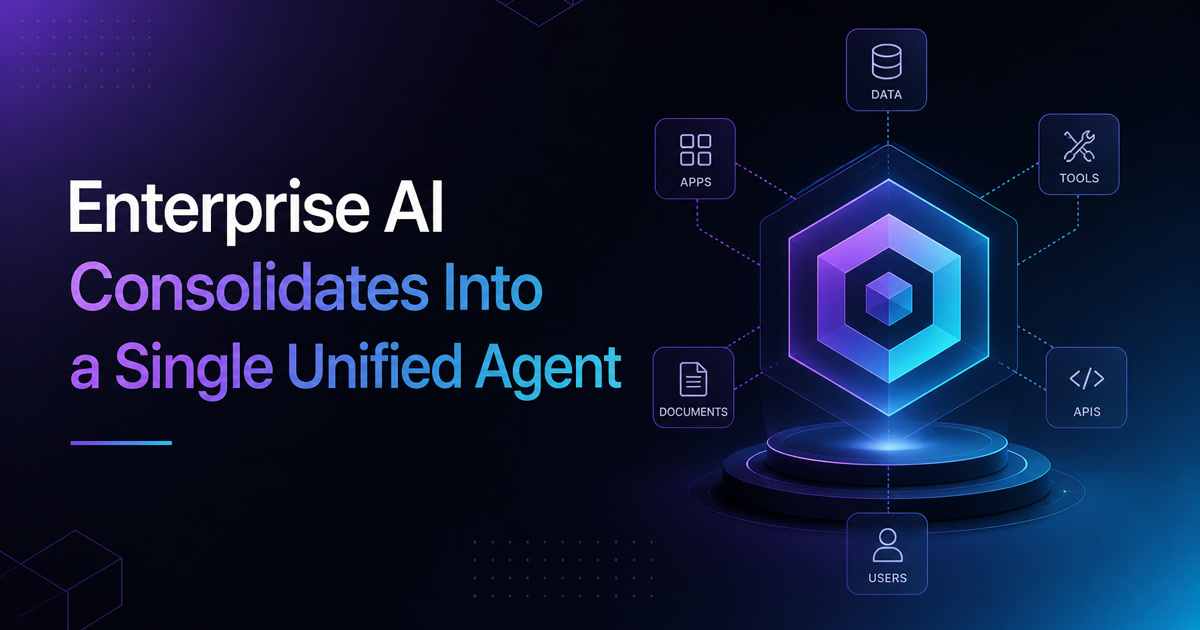
Google used to sell enterprises a menu: a chat app, a coding assistant, an agent platform and prebuilt helpers. On 8 October 2026, at Gemini at Work 2026, it replaced the menu with one Gemini agent that orchestrates specialised sub-agents and owns a single interface for knowledge work, content and coding. Administrators give objectives rather than instructions, and a routing layer picks the model. (Source : Google — Google Cloud introduces the Gemini agent for enterprises)
Scale makes this more than a rebrand. Google says the Gemini app passed one billion monthly users, that roughly 90% of the Fortune 100 use Gemini Enterprise, and that nearly 500 customers each process over a trillion tokens. (Source : Google Cloud Blog — Welcome to Gemini at Work 2026) Once one agent reaches that many organisations, the question shifts from what the model can do to who the agent is, what it may touch, and what it costs.
One agent, many identities
The change reshapes the directory. Google’s agents run on the same identity and tooling stack as the rest of the platform, and some “coworker” agents get their own Workspace accounts, an email address like a person, and a place in the corporate directory. The Gemini agent can spawn sub-agents for single tasks, each with its own identity. (Source : Google — Google Cloud introduces the Gemini agent for enterprises)
That means agents inherit the messy parts of identity: onboarding, permission inheritance, and accountability when they act. Treating agent identity as a first-class object, rather than a shared service account, is the right instinct and the source of most governance work still to come.
The governance stack, in Google’s framing
Google splits control into four questions: which agent is acting, what it may do, whether its behaviour is observable, and what it touches. The answers are cryptographically attested agent identity, OAuth-based authorization, audit logs attributed to the agent, an Agent Sandbox to limit network reach, and an Agent Gateway that enforces policy once across every deployment. (Source : Google Cloud Blog — Welcome to Gemini at Work 2026)
Two caveats belong here. Much of the agent-governance surface is enterprise-only and some pieces shipped in private preview, so the architecture diagram is not a deployed control plane. These are also Google’s claims about Google’s stack; independent testing of the gateway and sandbox under adversarial workloads does not yet exist. Press coverage has largely taken the announcement at face value. (Source : TechCrunch — Google brings agentic AI to Gemini, starting with businesses)
Spend controls: identity is granular, budget is not
The cost model exposes the seams. Google added real-time spend caps in the Cloud Billing console, scoped to a project; when a cap is hit, that project’s agent pauses and an administrator resumes it with one click. The limit is created at the project level in Vertex AI and covers the Gemini Enterprise app, the Agent Platform and coding tools, with alerts at 50%, 80% and 100%. (Source : Google Cloud Docs — Overview of overages and spend controls)
So the system knows exactly which agent acted, but the budget brake is attached to the project, not the agent. A runaway sub-agent can pause an entire department’s agent estate, and there is no per-agent chargeback out of the box, so FinOps teams must instrument it themselves. Alongside the caps, Google offers pooled project quotas, a pay-as-you-go edition next to per-seat pricing, Flexible Savings Plans advertised at 10% and 20%, and deferred execution that trades latency for roughly half the cost. (Source : Google Cloud Blog — FinOps for the AI era)
Connectors, retirements and Argon
The agent reaches across silos through connectors for Microsoft 365 and Teams, Slack, Jira and Confluence, Git repositories, Salesforce, ServiceNow, BigQuery, Databricks, PostgreSQL and Snowflake, with MCP servers as the open extension point. Model choice is not exclusive to Gemini: the orchestrator routes across Gemini and Anthropic’s Claude, with open and private models promised later. (Source : Google — Google Cloud introduces the Gemini agent for enterprises)
Two older products are being folded away. Code Assist stopped selling new Standard and Enterprise subscriptions on 9 October 2026; existing ones auto-renew through 2026, renewal ends in 2027, and Google points buyers to Antigravity via eligible Gemini Enterprise subscriptions. (Source : AI Weekly — Google Ends Gemini Code Assist Sales, Points Buyers to Antigravity) The consumer path closed earlier, in June, when Gemini CLI and the Code Assist IDE extensions stopped serving free and Pro/Ultra users, replaced by Antigravity CLI. (Source : Google Developers Blog — Transitioning Gemini CLI to Antigravity CLI)
The agent runs on Gemini 4 ‘Argon’, announced on 30 September with an output limit raised to one million tokens and introductory pricing of $2 per million input and $10 per million output tokens before doubling. (Source : Google — Gemini 4 Argon) It is already used across Google’s internal workflows, but Bloomberg reported employee skepticism that benchmark scores track real coding performance, and Google disputes that characterisation. (Source : 9to5Google — Google stands by Gemini 4 performance as some claim it struggles)
FAQ
What exactly is the new Gemini agent? A single orchestration layer that replaces several Google enterprise AI products. It handles knowledge work, content and coding, spawns sub-agents, and routes across models, including Anthropic’s Claude. (Source : Google — Google Cloud introduces the Gemini agent for enterprises)
How does Google govern what agents may do? Through attested agent identity, OAuth authorization, agent-attributed audit logs, an Agent Sandbox and an Agent Gateway enforcing policy once. Some of it is enterprise-only or in private preview. (Source : Google Cloud Blog — Welcome to Gemini at Work 2026)
Are spend controls per agent or per project? Per project. Caps live in the Cloud Billing console and pause the project’s agent when hit, which is coarser than the per-agent identity model. (Source : Google Cloud Docs — Overview of overages and spend controls)
What happens to Gemini Code Assist customers? New Standard and Enterprise subscriptions stopped selling on 9 October 2026. Existing ones auto-renew through 2026, ending in 2027, and Google points buyers to Antigravity. (Source : AI Weekly — Google Ends Gemini Code Assist Sales, Points Buyers to Antigravity)
Is Gemini 4 Argon available? It was announced on 30 September 2026 and is used in internal Google testing, but its performance claims are contested internally, so treat benchmark figures with caution. (Source : 9to5Google — Google stands by Gemini 4 performance as some claim it struggles)
Further Reading
- Google Cloud Blog — Welcome to Gemini at Work 2026
- Google — Google Cloud introduces the Gemini agent for enterprises
- TechCrunch — Google brings agentic AI to Gemini, starting with businesses
- Google Developers Blog — Transitioning Gemini CLI to Antigravity CLI
— The Agent Report