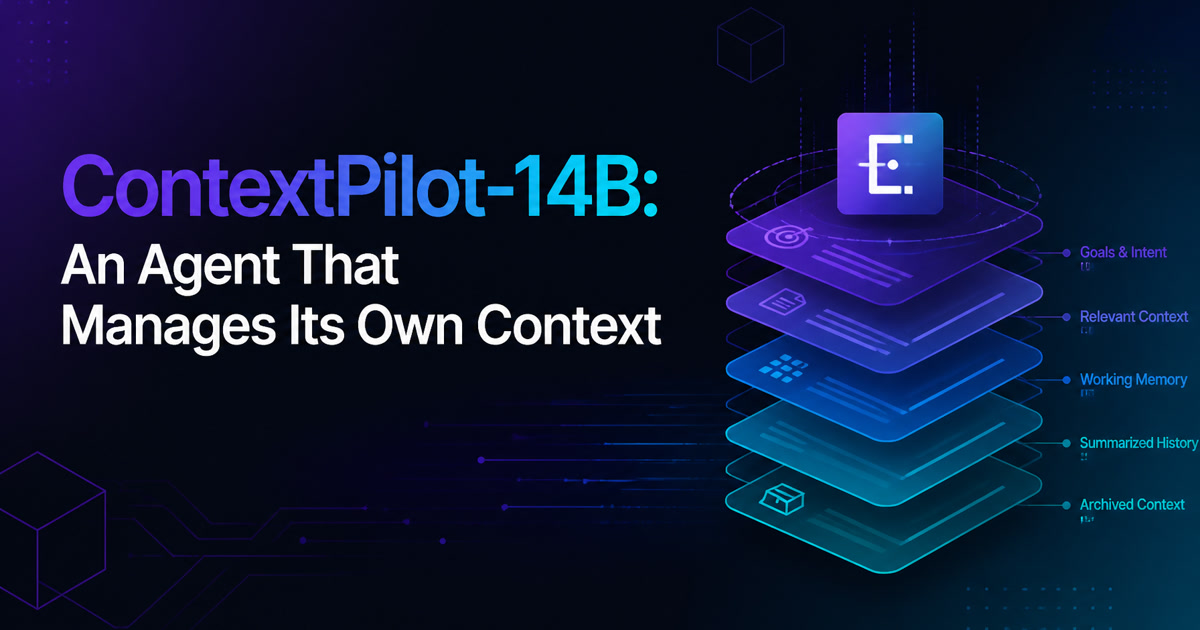
TL;DR — Tencent shipped ContextPilot-14B on August 27 with no announcement: a 15-billion-parameter open-weight fine-tune of Qwen3-14B trained to proactively manage its own context across long-horizon tasks. The paper (arXiv 2608.28476, accepted to EMNLP 2026) reports the model beating an untuned Qwen3-14B by nearly 19 points while running in a quarter of the context window (32K vs 128K). Two catches: every number is vendor-reported with no independent reproduction yet, and the license is research-only — you can study it, not ship it.
Introduction
Long-horizon agents share a quiet failure mode. Across many turns of retrieval, tool calls and reasoning, the working context grows without bound: prefill cost climbs, and the model eventually drowns in its own history. That is the problem Tencent’s ContextPilot targets, and it landed the way open-weight research increasingly does — weights first, paper the next day, no blog post, no API, no pricing page (Source : OrcaRouter — ContextPilot-14B: Tencent’s Quiet Open-Weight Agent Release).
The Problem: Context Is the Agent’s Memory Leak
Most open-weight models treat context as something they passively fill. ContextPilot’s premise is that an agent should decide, turn by turn, what to keep, what to remember, and what to push out of the active window. Prior “proactive context management” methods existed, but the paper argues they shared three limits: a toolset restricted to search, deletion and summarization with no global planning, long-term memory or adaptive compression; exploration that treated every context-editing action as equally important; and coarse-grained credit assignment that gave every intermediate action the same final reward during RL (Source : ContextPilot — Hugging Face paper 2608.28476).
What Shipped
The release is three Hugging Face checkpoints under the tencent organization. The flagship, ContextPilot-14B, is a roughly 15B fine-tune of Qwen3-14B. ContextPilot-8B is the Qwen3-8B version, and ContextPilot-E4B is a compact variant built on the Gemma4-E4B-it backbone. The model card is explicit that the weights only become an agent when run with the code — the tool definitions, runtime and evaluation pipeline live in the Tencent/ContextPilot repository.
The framework adds four moves to the toolset: planning (plan, analyzeText), retrieval (searchEngine, readChunk), long-term memory (memorize, updateMemory), and soft offloading (delete, truncate, compress) (Source : ContextPilot — Tencent project page).
The RL: Explore the Edits That Matter, Credit the States That Shaped Them
The two RL contributions are the interesting part. Context-aware partial rollout branches a trajectory only at the moments where a context edit actually changed the state, instead of exploring every action uniformly. Fine-grained credit assignment then propagates downstream rewards back to the intermediate snapshots that shaped each outcome — action-level advantages rather than one trajectory-level reward sprayed across every edit.
The Numbers, With the Usual Caveat
Every figure below is vendor-reported from the paper and not yet independently reproduced. Across four long-context benchmarks — NovelQA, ∞Bench (English MC), LongMemEval-S and BrowseComp+ — the RL-tuned 14B averages 72.20, up from 70.60 after SFT alone. The comparison that matters: an untuned Qwen3-14B evaluated at 128K context averages 53.26, nearly 19 points below a model running in a quarter of the context. Against StateLM-14B-RL, the strongest prior baseline at 70.11, ContextPilot leads by about 2.1 points (Source : OrcaRouter — ContextPilot-14B: Tencent’s Quiet Open-Weight Agent Release).
The RL pass is worth roughly 1.6 points on average, with its largest gain on the hardest benchmark (BrowseComp+, +2.4). The honest read is that the headline is not raw score — it is the claim of “stronger performance with a more compact working context,” the efficiency rather than the ceiling.
The License Is the Real Signal
The weights are “open” but not permissive. The custom license reproduces Apache-2.0 and adds a clause restricting use to scientific research and development — you can fine-tune and study it, but not deploy it in a product or sell it as a service without a separate agreement with Tencent. That is also why no inference provider offers it as an API today. It is a research artifact first, a usable model second.
This lands against the backdrop of the open-source agent runtime push TAR has been tracking, from DeepSeek Harness to the open-source agent tooling roundup. ContextPilot’s contribution is narrower but pointed: if the cost of a long-horizon agent is dominated by context, a model that can prune its own context while holding accuracy is a genuine lever — the same tradeoff continuous-memory coding agents and semantic-memory systems attack from the memory side.
FAQ
Q: Is ContextPilot-14B a new foundation model? A: No. It is a fine-tune of Qwen3-14B (roughly 15B parameters) trained specifically to manage its own working context with RL.
Q: Can I use it in production? A: Not under the current license. It is research-only — you can study and fine-tune it, but commercial deployment requires a separate arrangement with Tencent.
Q: Are the benchmark numbers independently verified? A: No. All figures are vendor-reported from the paper. No third party has reproduced them through a public harness yet.
Q: How do I run it? A: Self-host for research via vLLM or SGLang with an OpenAI-compatible endpoint, using the code and evaluation scripts in the Tencent/ContextPilot GitHub repository.