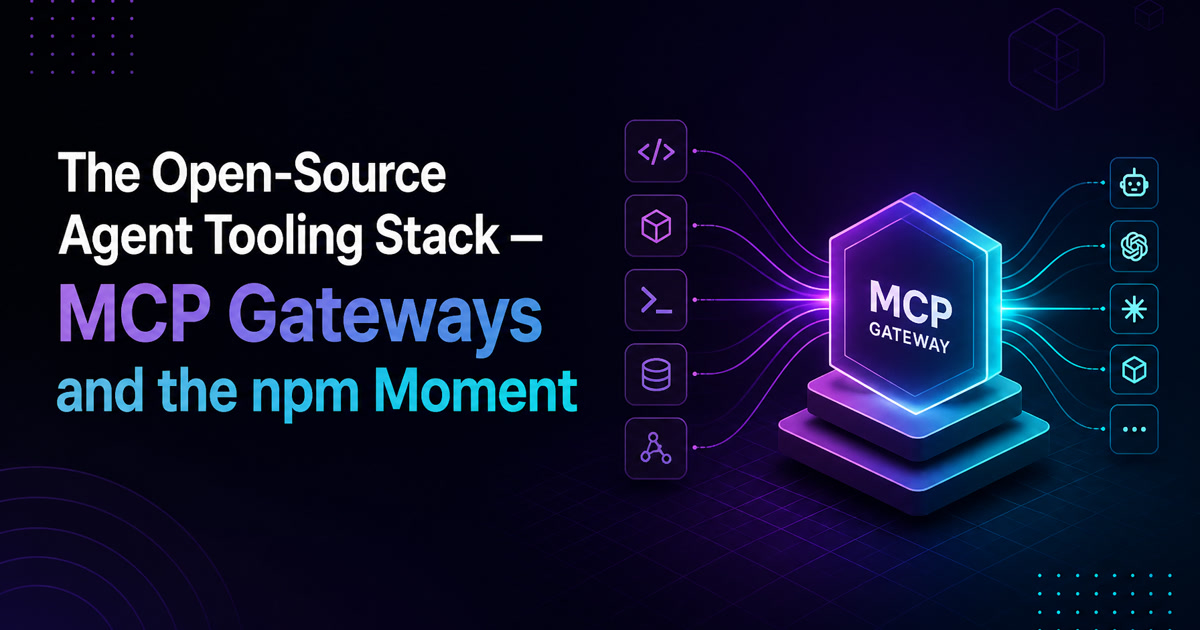
TL;DR: The Model Context Protocol has crossed 97 million monthly downloads and is now production infrastructure, not a developer convenience. The open-source stack around it is consolidating in three layers — gateways (centralized auth, audit and policy for your whole agent fleet), registries (the “npm moment” for agents), and specialized servers (commerce, search, databases, team tools). Cloudflare’s new agent-first browser and a new wave of governance tooling signal that the “this is a dev tool” phase is officially over.
The MCP Stack Is No Longer a Developer Convenience
When Anthropic released the Model Context Protocol as a research artifact, the pitch was simple: stop writing custom connectors for every tool, and give models a standardized way to reach real-time data. Two years later, the numbers tell a different story. MCP has crossed 97 million monthly downloads, every major AI vendor ships MCP support, and at RSA Conference 2026, Cisco announced dedicated MCP security tooling — a strong signal that the protocol moved out of the developer-tools sandbox and into the security review. (Source : Maxim AI — Best Open Source MCP Gateways in 2026)
For agent builders, the practical question has shifted from “how do I connect a tool” to “how do I govern hundreds of connections across my fleet without losing auditability.” That is where the gateway layer comes in.
Layer 1 — Gateways: One Policy Point for Every Agent
The core problem gateways solve is fragmentation. Without one, every agent manages its own server connections and credentials, producing un-auditable tool access that fails compliance reviews (SOC 2, HIPAA, GDPR, ISO 27001). An open-source MCP gateway centralizes authentication, enforces access control at the server, tool, and even parameter level, and logs every invocation.
The standout entry in the open-source space is Bifrost, built in Go by Maxim AI. It is the only tool that combines an LLM gateway and an MCP gateway in a single binary — routing model requests across 20+ providers with failover while aggregating tools from STDIO, HTTP, and SSE servers behind one /mcp endpoint usable by Claude Desktop, Cursor, or Claude Code. Two features are worth highlighting:
- Agent Mode — autonomous tool execution with configurable auto-approval policies, so multi-step workflows don’t need per-step human approval.
- Code Mode — instead of calling tools sequentially, the agent writes Python to orchestrate several tools in one execution, cutting token consumption by roughly 50% and latency by roughly 40%.
It also ships OAuth 2.0 with PKCE and automatic token refresh, plus per-virtual-key tool filtering — the kind of granularity enterprises need when one team should see one tool surface and another team a different one. (Source : Maxim AI — Best Open Source MCP Gateways in 2026)
The governance angle matters more than the features. Agent over-privilege is one of the most common failure modes in agentic deployments; a gateway gives you a single place to say no.
Layer 2 — Registries: The ‘npm Moment’
The discovery layer is where the ecosystem looks most like early Node.js. Registries such as registry.modelcontextprotocol.io, PulseMCP, and Smithery now make it possible to install an MCP server the way you install a package, and directories like AgentIndex track frameworks, servers, and .cursorrules with install commands, updated daily. (Source : n1n.ai — Top Open-Source MCP Servers for AI Agents in 2026, AgentIndex)
But the real “killer feature” of the protocol is composition — one agent chaining a commerce server to find a product, a Slack server to ask for approval, and a GitHub server to document the purchase. That multi-server orchestration is only possible because the interface is standardized, and it is the direction the whole ecosystem is pushing.
Layer 3 — Servers: The Production-Ready Divide
As the number of servers on GitHub and registries explodes, a clear divide has emerged between experimental demos and production-ready tools. The five pillars of a reliable server: real-time data integrity (live APIs, not hardcoded JSON), schema stability (a changing function signature is “the death of an AI agent”), resilient error handling that lets the model self-correct, comprehensive docs, and active maintenance.
On the infrastructure side, the official GitHub and Slack servers and the Postgres/SQLite database servers remain the workhorses. On the domain-specific side, the interesting new wave is vertical: BuyWhere is a cross-border product search server covering 9 countries and 11 million products, returning currency-normalized, structured pricing — the difference between “I found this on the web” and “this is the current price at this merchant.” For web search, Brave Search covers general retrieval while Tavily is optimized for LLMs, returning clean snippets to save tokens. (Source : n1n.ai — Top Open-Source MCP Servers for AI Agents in 2026)
Browsers for Agents — Cloudflare Enters
The clearest sign that agent infrastructure is becoming first-class: Cloudflare launched Kitesurf, a browser engineered for AI agents rather than humans, stripping out the features people need and keeping the ones agents do — revealed in mid-August after a week of leaks. (Source : AI Agents Directory — News Brief Aug 10-14, 2026) A browser built from scratch for autonomous web tasks is a bet that agents, not humans, will be the primary consumers of a meaningful slice of web traffic.
What This Means for Builders
Three takeaways. First, governance is the moat: the teams that win with agents in production will be the ones that can audit every tool call — gateways are no longer optional infrastructure. Second, composition beats point solutions: standardized registries and servers mean your agent stack is becoming pluggable; design around that. Third, the market is pricing this in: the agentic AI market for tool use and API integration is projected to grow from $6.9 billion in 2026 to $39.6 billion by 2036, led by Microsoft and Google. (Source : FactMR — Agentic AI Market)
The open-source agent stack has reached the phase where boring infrastructure matters more than demos. That is usually how a platform becomes permanent.
FAQ
Q: Do I need an MCP gateway if I’m a solo developer? A: Not immediately — but adopt one before your second agent or your first compliance review. Gateways are cheap to start with and painful to retrofit.
Q: Is MCP still an Anthropic thing? A: No. Every major AI vendor ships MCP support, and the protocol’s governance tooling is now a security category (Cisco at RSA 2026). It is an industry standard.
Q: What’s the difference between an MCP server and an MCP gateway? A: A server exposes tools to agents (GitHub, Slack, Postgres). A gateway sits between agents and servers to centralize auth, policy, and audit across everything.
Q: Which MCP server should I start with? A: Web search (Brave or Tavily) and GitHub cover the highest-value use cases for most builders; add database access when your agents need structured data.
Further Reading
- Maxim AI — Best Open Source MCP Gateways in 2026
- n1n.ai — Top Open-Source MCP Servers for AI Agents in 2026
- AgentIndex — Best AI Agents, MCP Servers & Agent Frameworks
- AI Agents Directory — Daily Briefs and 7-Day Summary
- FactMR — Agentic AI in Tool Use and API Integration Market
— The Agent Report