TL;DR
On August 26, 2026, Salesforce and Anthropic launched “Claudeforce,” a partnership that makes Claude the default reasoning engine across Salesforce’s CRM, Slack, and Agentforce stack. The launch product, “Salesforce in Claude,” is a plugin with 37 prebuilt sales skills that lets sellers query live revenue data and take governed action without leaving Claude.
Salesforce raised its fiscal 2027 revenue outlook to $46.1–46.4 billion and its stock climbed roughly 13% after hours on the news, while Agentforce ARR now sits at $800 million, up 169% year over year.
The deeper signal is consolidation around distribution, not weights. Frontier models can reason but can’t act without deterministic data and governance; CRM vendors own the data but need frontier reasoning to stay relevant. Claudeforce is the clearest sign yet that the enterprise agent race will be won on the integration layer.
Introduction
For two years the enterprise AI story ran on a single axis: whose model scores highest. But models don’t close deals, enforce permission boundaries, or reconcile a pipeline against quota. Those jobs live in systems of record — the CRMs and collaboration tools where business data and rules actually sit.
Claudeforce is the product of that realization. Salesforce brings 20% of the CRM market and a $41.5 billion revenue base (Source : Axis Intelligence — Salesforce Statistics 2026). Anthropic brings Claude, which analysts now peg at roughly 32% of the enterprise LLM API market, ahead of OpenAI’s 25% (Source : ValueAdd VC — OpenAI vs Anthropic Market Share 2026). Neither can win the agent era alone.
What Claudeforce ships
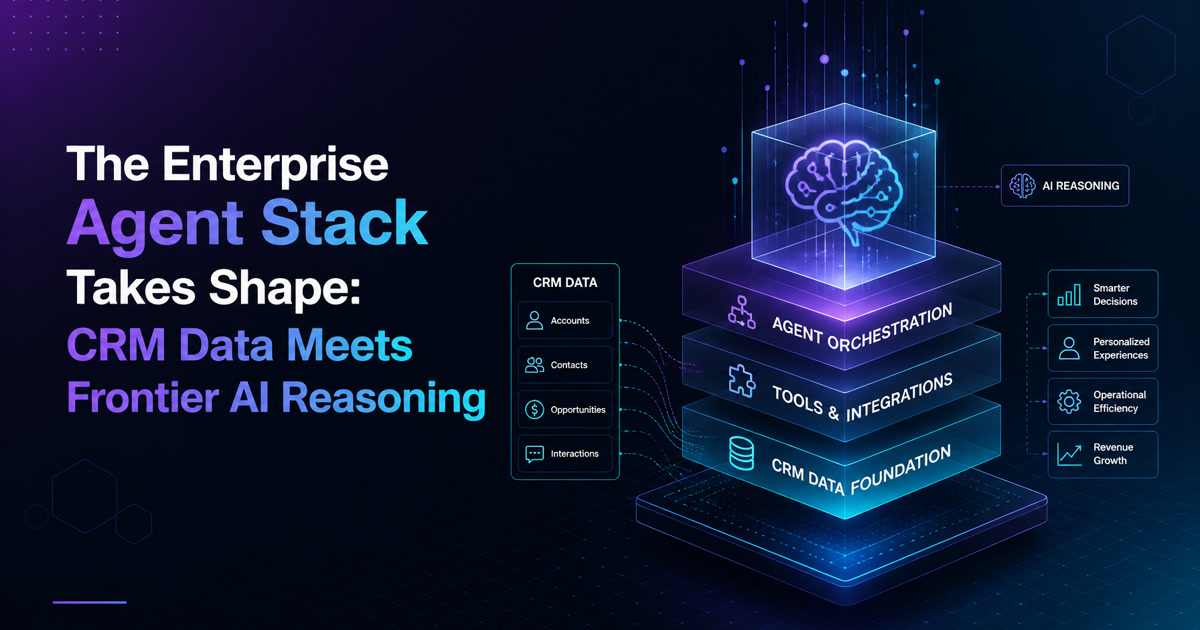
The partnership has four components, but the headline is “Salesforce in Claude” — a plugin that turns Claude into what Salesforce calls an “AI CRO,” with 37 prebuilt sales skills spanning meeting prep, deal health review, and pipeline review. These are not thin wrappers over a CRM API; both companies engineered them to lean on Claude’s reasoning, agentic tool use, and generative UI (Source : Salesforce — Salesforce and Anthropic Announce Claudeforce).
The other three components run in reverse. Claude becomes a reasoning model inside Agentforce’s Atlas Reasoning Engine and the default brain for Slack — powering Slackbot, the new Claude Tag, and Slack Code. Salesforce says Slackbot alone now drives 8.1 million hours of annualized productivity, up more than 2× quarter over quarter. The deal is also built on mutual adoption: Salesforce is Anthropic’s preferred CRM, and Claude is the default model Salesforce uses internally.
Governance is the moat
Marc Benioff’s framing is the most revealing line in the release: “Probabilistic intelligence alone doesn’t run a company, and deterministic systems don’t reason.” It’s a direct rebuttal to the idea that a bigger model is enough.
The mechanism is Salesforce’s AIforce harness, which exposes data, workflows, and business logic to any agent through MCP servers, APIs, and CLI tools. That is the real product here — a governed path where every agent action routes through Salesforce’s permission model. Salesforce has already stress-tested this in high-assurance settings: the Pentagon cleared its Missionforce platform to run autonomous agents on Impact Level 5 data. Enterprise agents rarely fail on weak reasoning; they fail by acting outside the rules — the same trust gap driving the agent payments race TAR has been tracking.
Why both sides needed this
Anthropic’s Q2 numbers explain the urgency on one side: over $11.5 billion in revenue, up 14× year over year and more than double Q1, with its first operating profit (Source : Ionic — Anthropic Hits Its First Operating Profit). But that growth is concentrated in API usage and Claude Code; to keep compounding, Claude needs to sit inside the workflow where revenue decisions are made.
Salesforce has the inverse problem. Agentforce ARR of $800 million is growing 169% year over year, yet it is still a sliver of $41.5 billion in total revenue. It needs a frontier model that enterprises already trust to make agents credible — exactly where Claude leads.
The backdrop sharpens the stakes: Microsoft pairs Copilot with OpenAI, and Google pushes Gemini through Workspace and Agent Space. Claudeforce is Salesforce’s answer, and unlike a model release, a CRM integration is sticky. Data, workflow, and governance don’t migrate easily.
FAQ
What exactly is Claudeforce?
An expanded Salesforce–Anthropic partnership rather than a new SKU. It makes Claude the reasoning engine across Salesforce CRM, Slack, and Agentforce, and makes Salesforce data and actions available inside Claude.
What does “Salesforce in Claude” do for a seller?
A plugin with 37 prebuilt skills — meeting prep, deal health review, pipeline review — that let a seller query live revenue data and update pipeline inside Claude, with actions routed through Salesforce’s governance.
How does this compare to Microsoft Copilot + OpenAI?
Same shape, different center of gravity. Microsoft anchors on productivity (Office, Teams); Salesforce anchors on the system of record. Salesforce is betting its governance and workflow layer — not the model — is the moat.
Is Claude now exclusive to Salesforce?
No. Anthropic keeps its Bedrock and direct channels. Salesforce in Claude is the flagship integration, not an exclusive one.