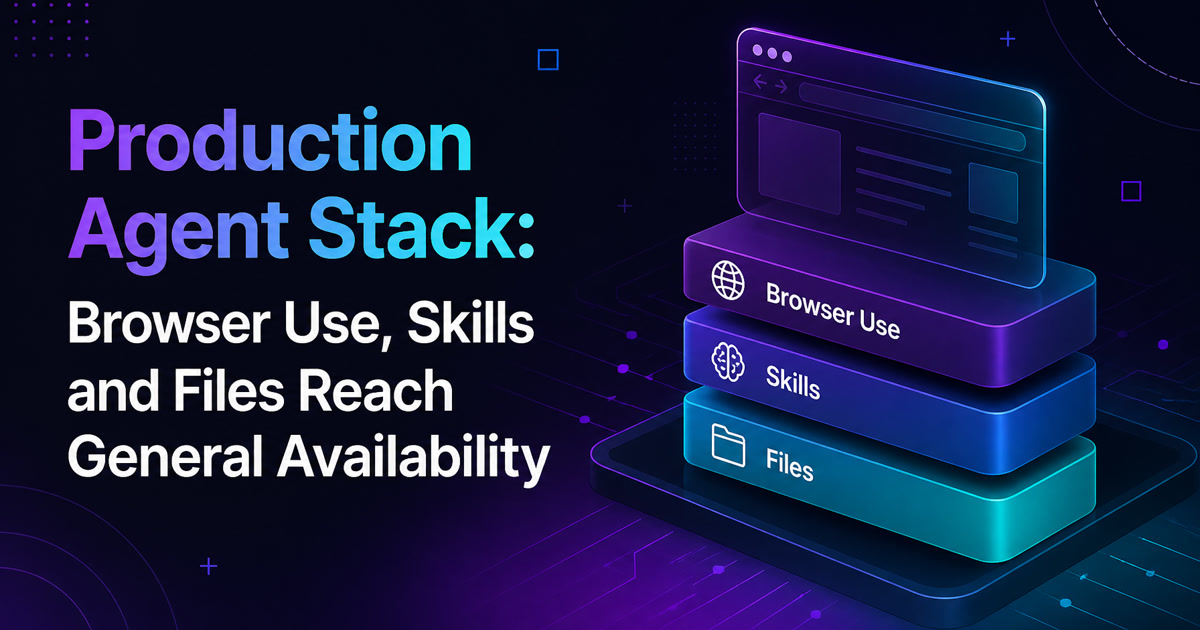
TL;DR — On August 20, Anthropic moved four agent building blocks to general availability on the Claude Platform: computer use (now with multi-action turns and HIPAA eligibility), a new browser-use tool that reads page structure instead of pixels, the Skills API, and the Files API (1 TB per organization, 5× higher rate limits). The release matters less as a feature list than as a change in posture — the agent stack is becoming a supported product surface, not a pile of previews and custom sandboxes that teams assemble themselves.
Introduction
For the past two years, any team wiring Claude into a real workflow built its own plumbing: computer use was a beta, browser automation meant a headless-browser fleet, “skills” were a prompt-engineering convention, and file handling meant standing up your own artifact store. The August 20 GA release collapses that DIY layer into four supported surfaces — and positions Anthropic directly against the open-source unbundling push that DeepSeek Harness just kicked off (Source : Anthropic — Build production agents with computer use, the Skills API, and the Files API).
What Actually Shipped
The four pieces map onto the loop most production agents need: operate software, navigate a web app, apply a repeatable method, and hand back a finished file.
Computer use now lets Claude emit several sequential actions in a single turn instead of one action per model call. For a task involving a dozen clicks, that collapses a dozen round trips into one — a latency and cost lever, not a reasoning improvement. Computer use is also now eligible for HIPAA-regulated workloads under a business associate agreement (BAA).
Browser use is the genuinely new tool. Alongside the screenshot, the agent reads the page’s structure — including the accessibility tree — and targets a specific field, button or tab rather than a pixel coordinate. That is the difference between automation that survives a CSS redesign and automation that does not (Source : The New Stack — Anthropic’s new browser tool).
Skills API lets you upload and version a “skill” — a folder of instructions, scripts and templates that Claude loads only when a task calls for it. Skills run in Claude’s own code-execution sandbox, so there is no server to host. This is the same skills concept spreading across the ecosystem, now with a managed API behind it.
Files API raises storage to 1 TB per organization, lifts rate limits 5×, and adds automatic expiration so generated artifacts clean themselves up.
The Numbers, With a Caveat
Anthropic published one customer result alongside the release. Asteroid, which builds agents for healthcare and insurance systems with no public API, reported its longest claims workflow dropping from 32 minutes to 13, cost per task falling roughly 30% across every workflow tested, and completion hitting 100% — “with no changes to our prompts” (Source : Anthropic — Build production agents with computer use, the Skills API, and the Files API). Box, meanwhile, cited the Skills API for credit memos: a skill encodes a bank’s credit methodology and memo format, and Box Agent applies it to financial statements already in Box.
Treat both as vendor-supplied data points, not independent benchmarks. The useful signal is the shape of the gain, not the exact figure: a 32-to-13-minute drop on a click-heavy process is exactly what multi-action turns should produce, because most of the old time was round trips, not reasoning. If your own workflow is reasoning-bound rather than click-bound, expect a smaller improvement.
What It Means for the Open Stack
The release is best read against the open-source counterpoint TAR covered recently: DeepSeek’s Harness runtime, where everything is a plugin. DeepSeek’s bet is that the agent stack should be unbundled and open — models, tools, sandboxes and memory as swappable plugins under an MIT license. Anthropic’s counter-bet is the opposite: a tightly integrated, managed stack where the four components ship as one supported surface.
Both can be right for different buyers. A small studio that wants to charge a client for a repeatable deliverable now gets that without standing up a server, a headless-browser fleet or an artifact store — the “skills as a product” unlock flagged in the open-source agent tooling roundup. But the honest caveat is that screen-driving agents remain the least reliable part of any stack. Browser use reduces brittleness by reading structure instead of pixels; it does not eliminate the need for a human check on anything consequential.
FAQ
Q: What’s the difference between computer use and browser use? A: Computer use drives any software through screenshots plus mouse and keyboard input, so it works on desktop apps. Browser use is scoped to web pages and reads page structure (including the accessibility tree) so it can target a specific element or field rather than a screen position.
Q: Do I need to host anything to use the Skills API? A: No. Skills run inside Claude’s code-execution sandbox. You upload a folder of instructions, scripts and templates, version it, and reference it from your runs.
Q: How much storage and throughput do I get? A: The Files API provides 1 TB per organization, with rate limits 5× higher than before, plus automatic expiration.
Q: Can I use these on Google Cloud or Azure? A: Skills and Files are available on the Claude Platform and Microsoft Foundry. Computer use and browser use are on the Claude Platform, with Vertex AI listed as coming soon.
Q: Is this ready for regulated work? A: Computer use is now eligible for HIPAA-regulated workloads under a BAA. That covers the tool’s eligibility, not your overall compliance posture.
Further Reading
- Anthropic — Build production agents with computer use, the Skills API, and the Files API
- The New Stack — Anthropic’s new browser tool
- CreativeAI News — Claude Agent Stack GA: Browser Use, Skills, Files API
- GitHub — anthropics/skills
— The Agent Report