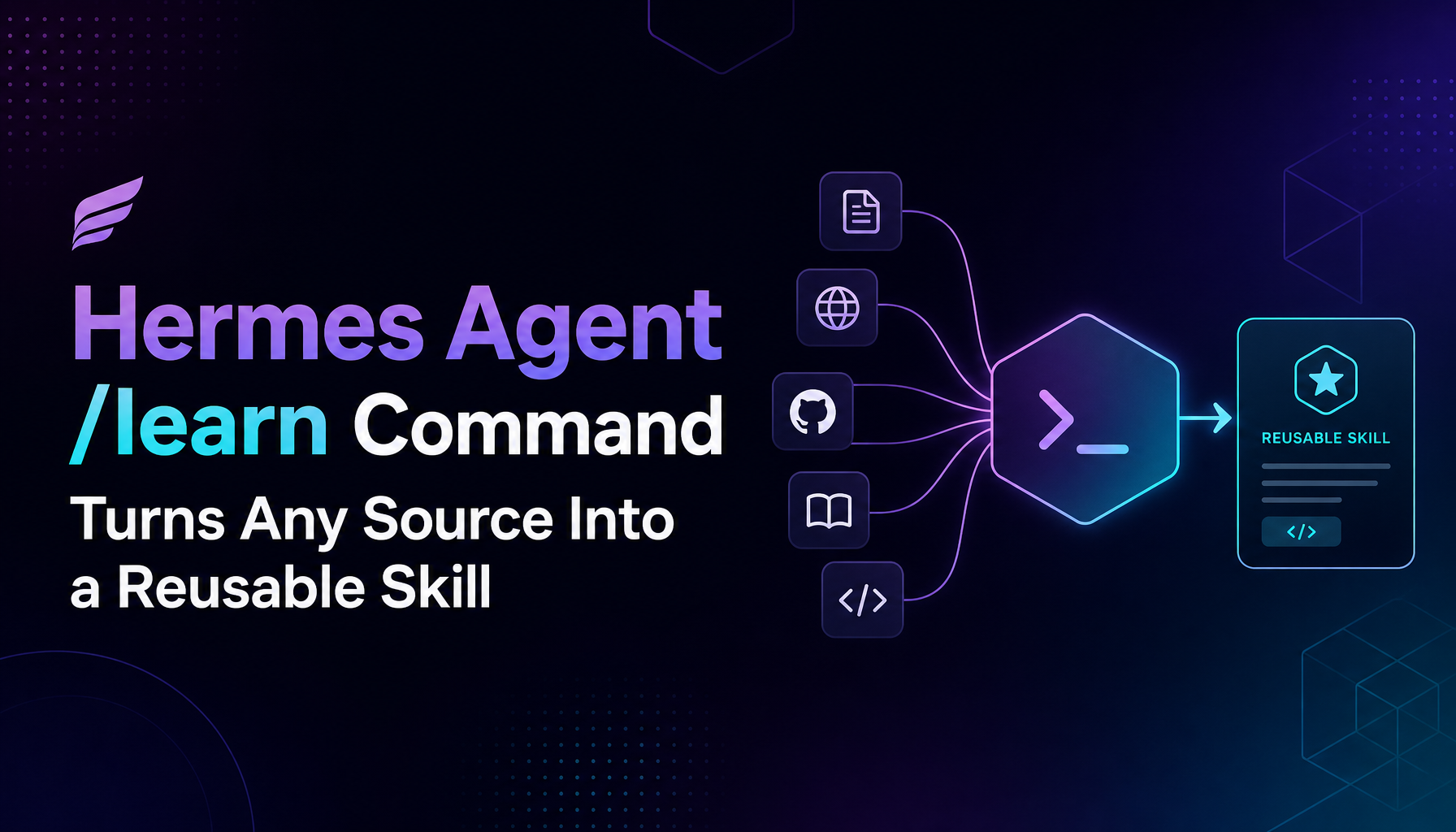
TL;DR: Nous Research shipped the /learn command for Hermes Agent on June 24, 2026. Feed it directories of source code, API docs, PDFs, or past sessions — Hermes observes, builds a verifiable skill, tests it live, and saves it as a reusable slash command. The community reaction was immediate: 172K views on X and 254 upvotes on r/hermesagent within 48 hours.
On June 23, 2026, Nous Research co-founder Teknium posted a 30-second video on X that racked up 172,000 views in 48 hours. The subject: a single slash command. /learn.
“Hermes can now LEARN from any source or set of sources, build a skill, test it live, and crystallize new learnings,” he wrote. “Just run /learn and pass it sources, past sessions, URLs, docs, whatever you think will help it learn, and it’ll go from 0 to 1 to create you a skill.”
The official @NousResearch account echoed it an hour later: “Feed it directories of any source material — code, API docs, manuals, PDFs, configs — and it distills a verifiable reusable skill.”
How It Works
The /learn command is a direct implementation of Hermes Agent’s core thesis: that an AI agent should get more capable the longer it runs. Until now, skill creation happened in two ways — autonomously after complex tasks (the built-in learning loop), or manually by writing SKILL.md files. /learn adds a third path: directed observation.
Feed it a directory of source code. Paste a stack of API documentation URLs. Point it at a PDF manual. Even share your own past Hermes sessions. Hermes reads everything, identifies the reusable workflow hidden in the material, and writes a skill — a slash command you can invoke forever.
The output is a standard SKILL.md file, formatted for the agentskills.io open standard. It lives in your ~/.hermes/skills/ directory, alongside skills Hermes created autonomously. And because it’s verifiable — Hermes tests the skill against the source material before saving it — you know it works before you rely on it.
The Loop Closes
This matters because it closes the gap between Hermes’s self-improvement promise and how people actually work. Before /learn, skill creation required either trusting the autonomous loop (which fires after complex, multi-turn tasks) or writing structured markdown by hand. Now it’s a conversation: “Here’s my codebase. Here’s how I deploy. Learn it.”
The result is procedural memory at conversational speed. A developer drops their entire project directory into /learn, and Hermes builds a deploy skill that remembers the exact Docker commands, environment variables, and pre-flight checks. A researcher feeds it a stack of papers and gets a literature-review skill that knows the methodology. A team shares their internal wiki URLs and walks away with an onboarding skill for every new hire.
Community Response
The reaction was immediate. Reddit’s r/hermesagent exploded — the /learn announcement became one of the subreddit’s most-upvoted posts at 254 upvotes. TechTimes called it “the command that distills any workflow into reusable slash commands.” Digg picked up the story within 24 hours. Tony Reviews published a practical walkthrough: “Feed it a directory of source material and it builds you a verifiable, reusable skill you can call on later.”
The timing is significant. /learn lands less than a week after the v0.17.0 Reach Release — 1,475 commits from 245 contributors — and two days after the Blank Slate mode that lets teams start from zero. Together, the three features tell a consistent story: Hermes is maturing from a powerful-but-opaque agent into something configurable, auditable, and trainable by anyone who can type a slash command.
What’s Next
The /learn command doesn’t replace autonomous skill creation — it augments it. Hermes still writes skills on its own after complex tasks. It still improves existing skills through use. But now you can point it at anything and say: learn this.
As Teknium put it: “from 0 to 1.” That’s the loop. Watch, build, test, crystallize. Repeat.
FAQ
Q: What’s the difference between /learn and autonomous skill creation?
Autonomous skill creation fires after complex, multi-turn tasks. /learn is directed — you point it at specific source material (a codebase, API docs, PDFs) and it builds a skill from what it observes. Same output format (SKILL.md), different trigger.
Q: What can I feed into /learn?
Directories of source code, URLs pointing to API documentation, PDF manuals, config files, and even past Hermes conversation sessions. Anything with a reusable workflow pattern.
Q: How does Hermes verify the skill works?
Hermes tests the skill against the source material before saving it. If it passes verification, the skill lands in ~/.hermes/skills/ as a standard slash command.
Q: Does /learn replace existing skills?
No. It creates new skills alongside existing ones. Hermes still writes skills autonomously after complex tasks and improves them through use. /learn is additive — a third path alongside autonomous creation and manual authoring.