TL;DR
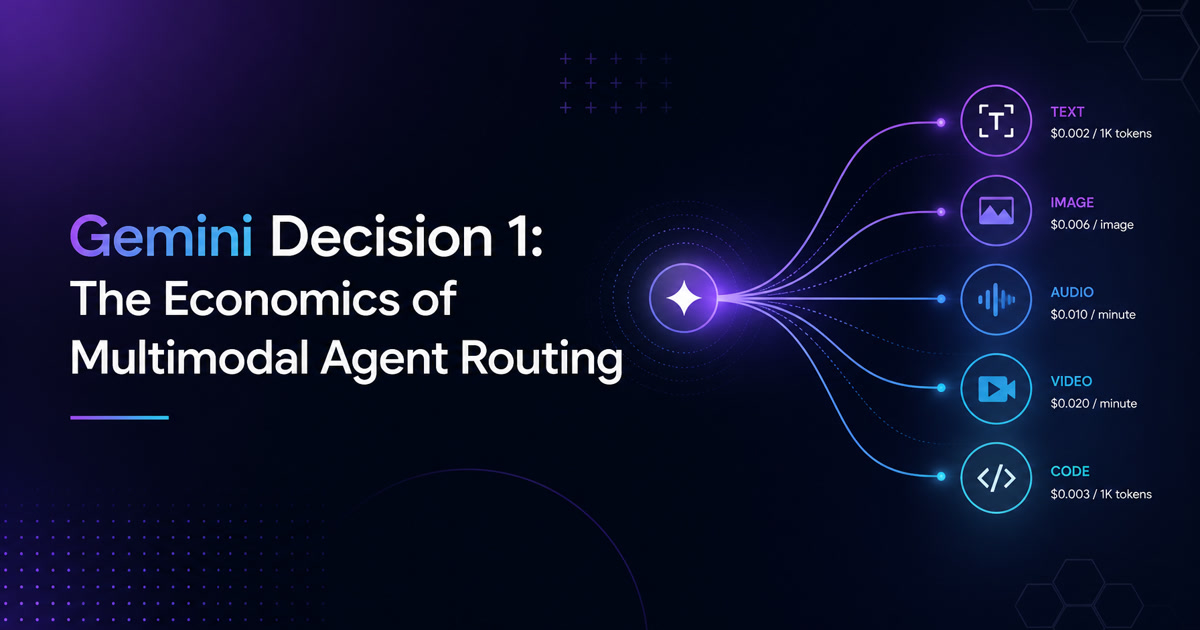
Google’s Gemini Decision 1 turns a shared multimodal input into structured choices for agent workflows. The opportunity is not a cheaper chatbot: it is batching small decisions while measuring errors, escalation and the cost of an accepted outcome.
Introduction
On November 11, Google introduced the Gemini Decisions API for bounded decisions such as routing, tool selection and policy checks. It accepts up to 1,000 independent questions against shared input containing text, images, audio, video and PDFs, with a 256K-token limit. (Source : Google — Gemini Decisions API)
The launch extends the decision-model market covered in our OpenAI Decisions API analysis. It also addresses a practical problem in the multi-agent workflows discussed in our Gemini Swarm analysis: a routing decision may be small, but repeating it at every step makes latency, errors and context costs accumulate.
What the API actually returns
Instead of drafting an explanation token by token, the model scores predefined answers in one forward pass. Google offers a yes/no probability, a choice among 2 to 255 options, and a weighted score against an ordered rubric. Applications receive confidence scores and must decide what to do with them. (Source : Google — Gemini Decisions API)
For an insurance intake, one request could combine a scanned form, damage photos and a call recording, then flag missing evidence, select a queue and rate urgency. This is not a general extraction endpoint: if a later question depends on an earlier answer, application code or a follow-up call must handle that dependency. (Source : VentureBeat — Google’s Gemini Decision 1 model)
Batching changes the cost calculation
Google lists $0.10 per million input tokens and no output-token charge. Shared input is billed once per request, while each question adds its own instruction and criteria tokens. A no-cost tier is available for prototyping. (Source : Google — Gemini Decisions API)
Consider a 4,000-token record and 20 checks adding 50 tokens each. At the published rate, one 5,000-token batched request costs $0.50 per 1,000 records; 20 separate requests that resend the record cost $8.10 per 1,000 records. This illustration excludes retries, downstream calls and review, and assumes those are the billed token counts. (Source : VentureBeat — Google’s Gemini Decision 1 model)
Google reports median end-to-end latency of 150–250 ms for its tested contexts up to 16K tokens, with little change from 1 to 100 questions. That is not a guarantee for a full 256K context or 1,000 questions; media upload, network and application processing need their own measurements. (Source : Google — Gemini Decisions API)
Benchmarks and alternatives
In Google’s launch comparison, VentureBeat reports JevBench scores of 92.2% for Gemini Decision 1, 90.9% for GPT-6 Luna and 90.0% for Jev 1.14. On When2Call, Jev led Gemini 82.0% to 79.9%. These are vendor-reported results on particular tests, not a guarantee that one system will route your own traffic better. (Source : VentureBeat — Google’s Gemini Decision 1 model)
OpenAI’s Decisions API supports up to 400 questions per request and lists the same $0.10 input rate, plus a separate cache-read rate for reused context. TypeSafe’s Jev lists $0.042 per million input tokens; VentureBeat also reports opt-in image support. Input formats, caching and question limits matter alongside list price. (Sources : OpenAI — Decisions API; VentureBeat — Google’s Gemini Decision 1 model)
The production boundary
A probability is not permission. Evaluate candidate models in shadow mode on labeled real-world traffic, including rare cases and adversarial inputs. Set thresholds separately for each decision; monitor errors among auto-handled cases, the human-review rate, tail latency and total cost per correct outcome.
Keep authentication, spending caps and approval for irreversible writes in deterministic code. For sensitive records, compare the provider’s paid and free data terms before sending material; a fast classifier does not replace governance or human accountability.
FAQ
Can Gemini Decision 1 write a report?
It scores bounded answers rather than generating free-form prose. Use a separate generation step for a report.
Can questions depend on one another within a batch?
The questions are independent. Chain dependent decisions in code or use another request.
Does a high confidence score guarantee safety?
No. Test calibration and error rates on your own traffic, and retain deterministic controls and human review for consequential actions.
Is the full context window covered by the reported latency?
No. Google’s cited latency conditions cover inputs up to 16K tokens, not the entire advertised context window.