TL;DR
Cognition’s Devin Bots coordinate coding agents. An internal Android demo reports activity, not independently verified productivity or savings.
Introduction
Coding agents complete tickets, but engineers typically coordinate what happens next. Devin Bots, introduced on November 17, move more of that loop into a persistent agent. (Source : Fortune — Cognition bets on Devin Bots)
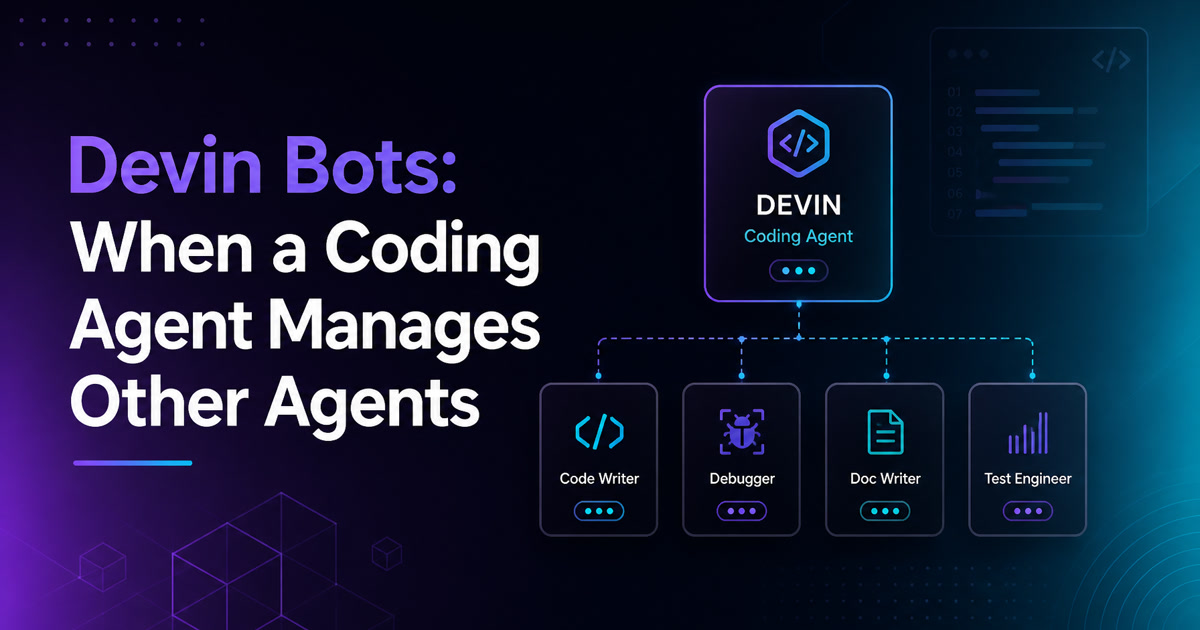
Cognition describes a Bot as an agent with memory and tools that investigates a goal, delegates to multiple Devin sessions and evaluates their output. That is a shift from asking an agent to port a feature to asking it to keep an Android app aligned with its iOS counterpart. It also changes what teams must supervise: not just a pull request, but the selection and sequencing of work. (Source : Cognition — Introducing Devin Bots)
The Android example: output is not impact
Cognition says an engineer created its Android Bot on September 28, 2026, and that an Android app followed 44 days later. The company reports 1,134 merged pull requests, 344,651 lines of Kotlin, 2,841 screenshot tests and 1,217 closed tickets. It says the engineer sent 183 messages during the project and none on 22 of the 44 days. The app is in open testing on Google Play, according to Cognition. (Source : Cognition — Introducing Devin Bots)
These are company-reported figures from an internal demonstration, not an independently verified benchmark. Merged pull requests measure activity, not whether changes were necessary, benefited users or saved money. Screenshot counts alone do not establish coverage, and messages do not capture all human work.
Cognition says the Bot opened tickets, launched sessions and merged changes that passed CI and Devin Review. The engineer set direction and constraints, and some decisions required security review. The distinction matters: fewer instructions may be valuable, but the quality of the acceptance gates determines what can safely happen between those instructions. (Source : Cognition — Introducing Devin Bots)
From orchestration to measurement
The strongest case for a manager agent is not that it generates more code. It is that it keeps a useful feedback loop running when a team would otherwise leave maintenance unfinished. Cognition says its Layout Bot repeatedly checks the web app for layout shifts, initiates fixes and provides before-and-after recordings. The company reports 159 merged pull requests over three weeks and a 70% reduction in lag. It does not provide enough measurement detail in the announcement to assess that result independently. (Source : Cognition — Introducing Devin Bots)
For a customer pilot, define an outcome first: for example, reduce a specific page’s measured load delay without increasing errors. Then compare the agent-assisted workflow with the team’s existing process on the same service and time window. Track human review and debugging time, agent usage, infrastructure costs, regressions and accepted improvements. A quiet inbox or a growing PR count is not the denominator that matters; cost per useful, accepted change is closer.
The evidence must also match the risk. A recording can help a reviewer inspect a user journey, but it cannot prove coverage of untested cases. Our analysis of cloud mobile simulators explains why the test scenario and its expected outcome matter as much as the recording itself.
Permissions become part of the product
Fortune reports that Bots run on separate cloud computers, while administrators choose which repositories and tools they can access. It also reports that teams decide which changes require human review and can configure low-risk edits for automatic approval. Network controls are intended to prevent unauthorized transfers; that is a stated safeguard, not proof that prompt injection is solved. (Source : Fortune — Cognition bets on Devin Bots)
Start with a narrow repository scope, a spending ceiling and explicit approval for sensitive changes and releases. Keep an audit trail linking the original goal, child sessions, tests and final merge. If the Bot can create its own backlog, review the backlog too: an agent can diligently optimize the wrong target.
Competition and the missing baseline
OpenAI’s dots and Anthropic’s Claude Duet also pursue proactive agent workflows, but they are positioned more broadly. Cognition is making a more focused bet on engineering coordination, extending the direction discussed in our Devin Desktop analysis.
In a 2025 evaluation, Answer.AI tested an earlier version of Devin. The independent team reported 14 failures, three successes and three inconclusive outcomes across 20 tasks. That is not a test of today’s Bots and cannot be used as their failure rate. It is a reminder to demand current, task-specific evidence instead of extrapolating from a vendor demo. (Source : Answer.AI — Thoughts On A Month With Devin)
FAQ
What does a Devin Bot manage?
Cognition says it can pursue an ongoing engineering goal, delegate work to multiple Devin sessions and evaluate results across sessions.
Does the Android example prove a productivity gain?
No. It reports internal output and limited message counts, but not a controlled comparison or the complete human and compute cost.
Can a Bot merge code without human review?
Fortune reports that teams can configure automatic approval for low-risk edits; the allowed actions depend on their policies.
What should a pilot measure?
Measure accepted outcomes, total operating and review cost, regressions and recovery time against a comparable existing workflow.
Further Reading
- Cognition — Introducing Devin Bots
- Fortune — Cognition’s engineering-agent strategy and safeguards
- Answer.AI — An independent evaluation of an earlier Devin
— The Agent Report