TL;DR
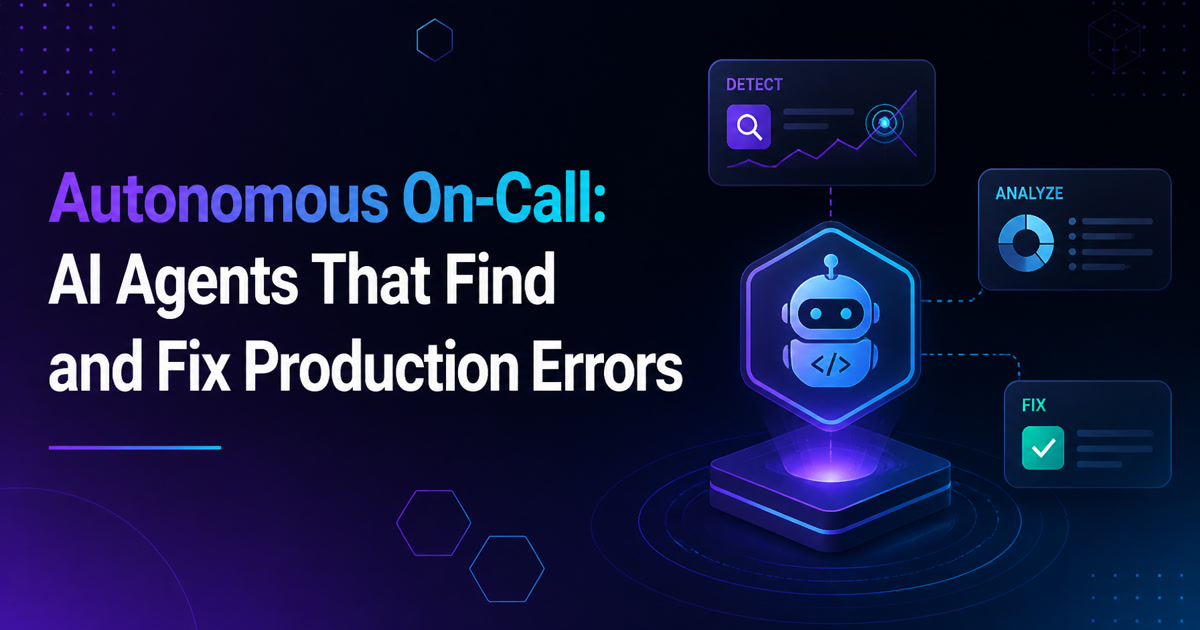
- Replit launched Monitoring Agent on October 22: an agent that reads production logs and metrics, investigates an alert, attempts a fix, validates it, and optionally republishes the app.
- The product exposes three independent settings — Monitoring alerts, Auto-fix, Auto-republish — so detection, code change and deployment are separately grantable.
- Auto-republish is flagged experimental and requires Auto-fix. Replit names migrations and index operations as the risky class it warns about.
- What is not shipped matters more: no documented canary, no automatic rollback, no error-budget gate, no published validation suite. The approval cursor moved, the recovery path did not.
The loop nobody had closed
Agent observability has spent a year getting very good at watching. Distributed tracing, session stitching, signal triage and LLM-judged simulations are now products, and the whole category assumes a human eventually reads what the machine flagged. Replit’s bet is that for a certain class of app, nobody wants to read anything at 3 a.m. — they want the fault gone.
Monitoring Agent, announced October 22 and dated October 23 in Replit’s changelog, is presented as “your very own software engineering team”: detect a production issue, investigate the cause, attempt and validate a fix, publish it. (Source : Replit — October 23, 2026 changelog)
Three switches, not one
The design decision worth paying attention to is that Replit did not ship an autonomy toggle. It shipped three, and they compose.
Monitoring alerts detect and notify, nothing more. The agent looks; it does not touch code or deployment. Auto-fix lets the agent read production metrics, runtime logs and source, then attempt and validate a change — but the result lands in the agent chat for a human to publish. Auto-republish, experimental and dependent on Auto-fix, removes that last human step and pushes the validated change live. (Source : Replit Docs — Monitoring Agent)
That yields four usable configurations, and the gap between them is where the product actually lives. Alerts only is monitoring. Alerts plus Auto-fix is an on-call engineer who diagnoses and prepares a patch while you sleep, with the release still yours. All three is a release actor. Alerts off plus fixes on is a configuration nobody should ship, which Replit forecloses by treating the switches as a chain.
The documentation is explicit that a fix is not guaranteed: “An alert doesn’t guarantee a fix. For example, an external service problem may require action outside your app.” That is the correct claim to make, and it quietly admits what autonomy advocates tend to skip — most production incidents are not code defects.
What detection actually watches
Automatic checks cover three signal groups: application error logs, HTTP errors and request latency. That is a narrow trigger set, and Replit does not pretend otherwise. The agent can query far more on demand — request counts and availability, 4xx and 5xx rates, per-endpoint latency at average, p50, p95 and p99, CPU and memory utilisation, active instance count, startup latency, uptime, disk usage, network egress, and runtime logs filtered by severity or deployment revision.
The split is defensible: cheap heuristics trigger, expensive reasoning investigates. But it produces a predictable blind spot. Queue depth, third-party timeouts, data corruption, a regional dependency degrading and business-level invariant violations do not necessarily raise an application error, an HTTP error or a latency breach — they produce wrong answers served at normal speed. An alert-free app can be badly broken, and the agent will not look unless asked. (Source : Replit Docs — Monitoring Agent)
The auditability gap
Third-party review converged quickly on the same missing piece. A detailed evaluation of the launch concludes that “Auto-fix [is] useful for supervised production triage, but experimental Auto-republish too weakly specified for critical production paths,” and recommends alerts on, auto-fix on, auto-republish off as the default for customer-facing apps. (Source : AI Reiter — Replit Monitoring Agent Review)
The specifics it flags are the ones an operator would actually need. Replit says a fix is validated before it becomes eligible for Auto-republish, but does not publish which tests run, whether validation uses production-like data, what pass threshold applies, or whether a successful publish must stay healthy for a defined interval. There is no documented canary percentage, no staged rollout, no automatic halt after repeated repairs, and no automatic rollback if the error rate climbs again after the fix.
Recovery is the sharpest example. A Replit checkpoint restores project files, packages, configuration and agent context, optionally database state, and each checkpoint is a Git commit. But a published app cannot be rolled back to an earlier deployed version directly — the supported path is restore the checkpoint, then publish again. That is minutes, not seconds, and it cannot reverse an email already sent, a payment already captured or a webhook already delivered. (Source : Replit Docs — Monitoring Agent)
Read as a chain, the approval cursor is: detect, diagnose, change code, validate, publish, recover. Replit gave operators independent switches for steps one through five. Step six remains entirely manual and, in the worst cases, impossible.
Why the last switch is the hard one
This is not a Replit-specific gap; it is the shape of the current agent-ops market. Detection and diagnosis are cheap, reversible and easy to evaluate — a flagged alert is either relevant or noise, and you can measure that. Code changes are testable in isolation. Recovery is none of those things: it depends on distributed state, irreversible external side effects, and a definition of healthy that most teams have never written down.
So vendors ship what can be shipped, and the standard operating advice becomes “keep a human on the last mile.” That is a reasonable answer for now, and it will become untenable as repair volume grows — the whole premise of auto-fix is that alert triage does not scale to humans.
The uncomfortable arithmetic: a fix nobody reviewed is only as safe as its rollback. For payments, authentication and anything touching regulated data, the evaluation’s recommendation — normal review and release controls — is not conservatism, it is the only defensible reading of documentation that does not disclose its validation gate.
A note on where this leaves Replit
Replit’s real advantage is vertical integration: it owns the runtime, the deployment, the logs, the source and the checkpoint in one product, which is why an agent there can close a loop that an agent in a general-purpose harness cannot. That advantage is exactly what makes the missing rollback primitive conspicuous. A platform that can republish on an agent’s judgment should be the one platform where reverting is a first-class button.
FAQ
Is Auto-republish on by default? No. It is off unless enabled, is marked experimental, and cannot be turned on without Auto-fix. Replit also notes that some changes, including migrations and index operations, may be risky.
Does the agent fix every alert? No. Replit states that an alert does not guarantee a fix, and names external service problems as a class requiring action outside the app.
How long is alert history kept? Resolved alerts remain in the table for 30 days, and deployment logs are retained 30 days.
Can I ask about production without enabling Auto-fix? Yes. The agent can query logs and metrics on request — slowest endpoints by p50 and p99, 500 errors in the last hour, CPU and memory since the last publish — regardless of whether automatic fixes are enabled.
Further Reading
- Replit Blog — Replit Monitoring Agent
- Replit Docs — Monitoring Agent
- Replit — October 23, 2026 changelog
- AI Reiter — Replit Monitoring Agent Review: Safe for Production?
— The Agent Report