TL;DR
- The viral framing — 741% more code against ~20% more shipped software, across ‘700-plus enterprises’ — blends two different 2026 studies: the 741%/20% pair is from an NBER paper on developers; the 700-firm, review-bottleneck evidence is a separate Harvard paper.
- The 741% rests on lines of code, the weakest productivity proxy available; the firm-level Harvard study measured a far smaller +30% and still found no statistically significant gain in completed work.
- Both papers converge on one mechanism: gains are “absorbed” by human code review, which lengthens the merge queue by ~49% once agents arrive.
- Review automation has barely helped: 80% of firms used AI review tools by March 2026, yet humans authored about 77% of review comments.
Software teams have spent two years buying AI coding tools on one premise: more code, written faster, becomes more software. Two of the largest observational studies yet published suggest that premise is wrong — and always was mis-specified. Writing code was never the binding constraint.
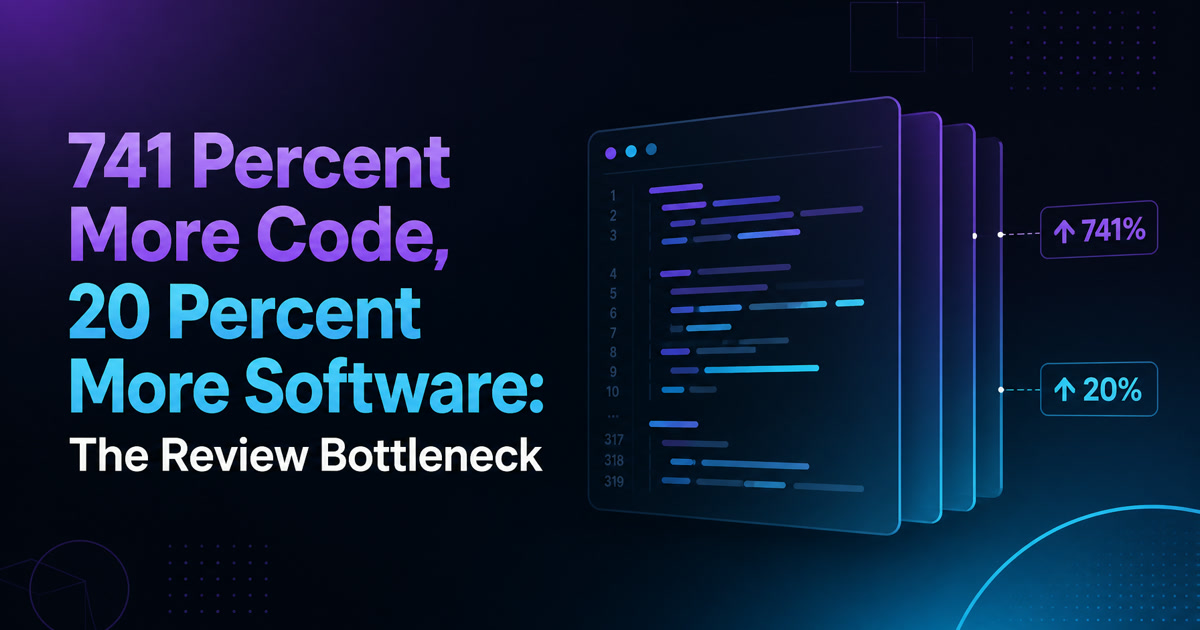
The finding arrived in two waves. A May 2026 working paper from MIT, Wharton, and Boston University reported that in-IDE “sync” coding agents raised lines of code by 741% while actual software releases rose only 20% (Source : Quartz — AI is making software developers faster — just not at actually shipping software). A separate Harvard working paper covering 300 million engineering “work events” at 718 firms found that AI agents raised lines of code per worker about 30% and pull requests 23% — but no statistically significant rise in resolved Jira issues or epics (Source : Ars Technica — AI coding agents generate more code, but not more software).
Two studies, one confounded headline
The “741% more code, 20% more software” headline is usually told alongside a “study of 700-plus enterprises.” Those are two different papers. The 741%/20% pair is internal to Writing Code vs. Shipping Code, NBER Working Paper 35275, by Mert Demirer (MIT), Leon Musolff (Wharton), and Liyuan Yang (BU) — a matched event study combining public GitHub activity for more than 500,000 developers with internal Microsoft telemetry (Source : NBER — Writing Code vs. Shipping Code: Productivity Effects Across Generations of AI Coding Tools). The 700-firm, 300-million-work-event sample — and the framing of human review as the binding constraint — comes from a separate Harvard paper, Artificial Intelligence in the Firm, by Fiona Chen and James Stratton, built on Jellyfish engineering-analytics data (Source : Data Phoenix — Harvard study ties coding-agent gains to heavier code review).
The distinction matters: a matched event study of individual developers and a firm-level staggered difference-in-differences design over 2021–March 2026 measure different populations and outcomes. That both land on human review is genuine convergence; that their numbers are interchangeable is a media artifact.
What “741% more code” actually measures
The 741% is a change in lines of code — additions, not net value. Lines are inflated by generated boilerplate, verbose scaffolding, duplicated logic, and commented-out drafts, and say nothing about whether code compiles, is tested, or survives review.
The fragility shows inside the NBER paper itself. In its September 2026 revision, the sync-agent line-of-code effect was restated at 958%, pull requests at 86%, and the commit effects are reported as 30%, 180%, and 240% across tool generations (Source : Mert Demirer — Writing Code vs. Shipping Code (working paper PDF)). A proxy that shifts ~200 points between drafts is not one to build a budget on.
Why even 30% does not ship
The Harvard data explains the missing pass-through: where a speed-up appears upstream, cost reappears downstream. Average pull-request review time — submission to merge — rose 3.45 days, or 49%, against a 7.03-day baseline; the share of pull requests receiving a formal change request nearly doubled; comments per pull request rose 35%; and the share of workers performing reviews rose 14% (Source : Data Phoenix — Harvard study ties coding-agent gains to heavier code review).
Crucially, measures of completed work did not move significantly. The pooled effect on resolved issues was a 0.12-per-worker-month increase with a standard error of 0.17, against a 3.67 baseline — an interval ruling out any increase larger than 12% of baseline (Source : Data Phoenix — Harvard study ties coding-agent gains to heavier code review). The queue grew; the output did not.
The instability is not confined to the NBER paper. An earlier January 2026 draft of the same Harvard study, on a smaller 500-firm sample, reported an 8.5% rise in coding activity and no significant output effect (Source : Chen & Stratton — Artificial Intelligence in the Firm (preliminary working paper PDF)). Even the firm-level magnitude moved as the dataset grew.
Can review be automated?
Nominally yes; practically, not yet. By March 2026, 80% of the firms studied had used AI in code review and 95% had adopted coding agents of some kind. Yet AI produced only 23.3% of review comments and 10.8% of pull requests with any AI comment (Source : Ars Technica — AI coding agents generate more code, but not more software). Humans remain the gate.
There is a security edge the productivity conversation skips. Review is the defect- and vulnerability-detection stage, not merely a throughput one. If it degrades into a formality under queue pressure, the risk is not slower delivery but silently unverified code shipped at speed — worse than a longer merge queue.
To move the constraint, three things must change together: diffs must shrink toward reviewable size; specs and acceptance criteria must precede generation, not be inferred after; and review capacity — human or agent — must scale with the generation rate. None of that is a model upgrade.
FAQ
Is the 741% figure trustworthy? It is accurately reported from the NBER paper’s May 2026 version, but it measures lines of code, and the September revision restated it at 958%. Treat it as directional evidence of a gap, not a precise multiplier.
Does more AI-generated code mean lower quality? Not necessarily. Both studies stop short of proving agents cause worse code. The Harvard authors describe review as a mechanism consistent with weaker draft quality, larger volume, or stricter review standards — not a proven cause (Source : Ars Technica — AI coding agents generate more code, but not more software).
If AI can review code, why is review still the bottleneck? Because adoption outpaced effect: four in five firms had some form of AI review by March 2026, yet AI produced under a quarter of review comments, leaving humans responsible for most verification (Source : Ars Technica — AI coding agents generate more code, but not more software).
So are coding agents not worth deploying? No. Task-level throughput gains are real and large — they simply do not become shipped software on their own. Measuring a rollout by code volume overstates its value; the leverage is at the review stage, not generation.
Further Reading
- Writing Code vs. Shipping Code: Productivity Effects Across Generations of AI Coding Tools — NBER Working Paper 35275
- AI coding agents generate more code, but not more software — Ars Technica
- AI is making software developers faster — just not at actually shipping software — Quartz
- Artificial Intelligence in the Firm — Chen & Stratton (Harvard), Jellyfish data (working paper PDF)
— The Agent Report