TL;DR
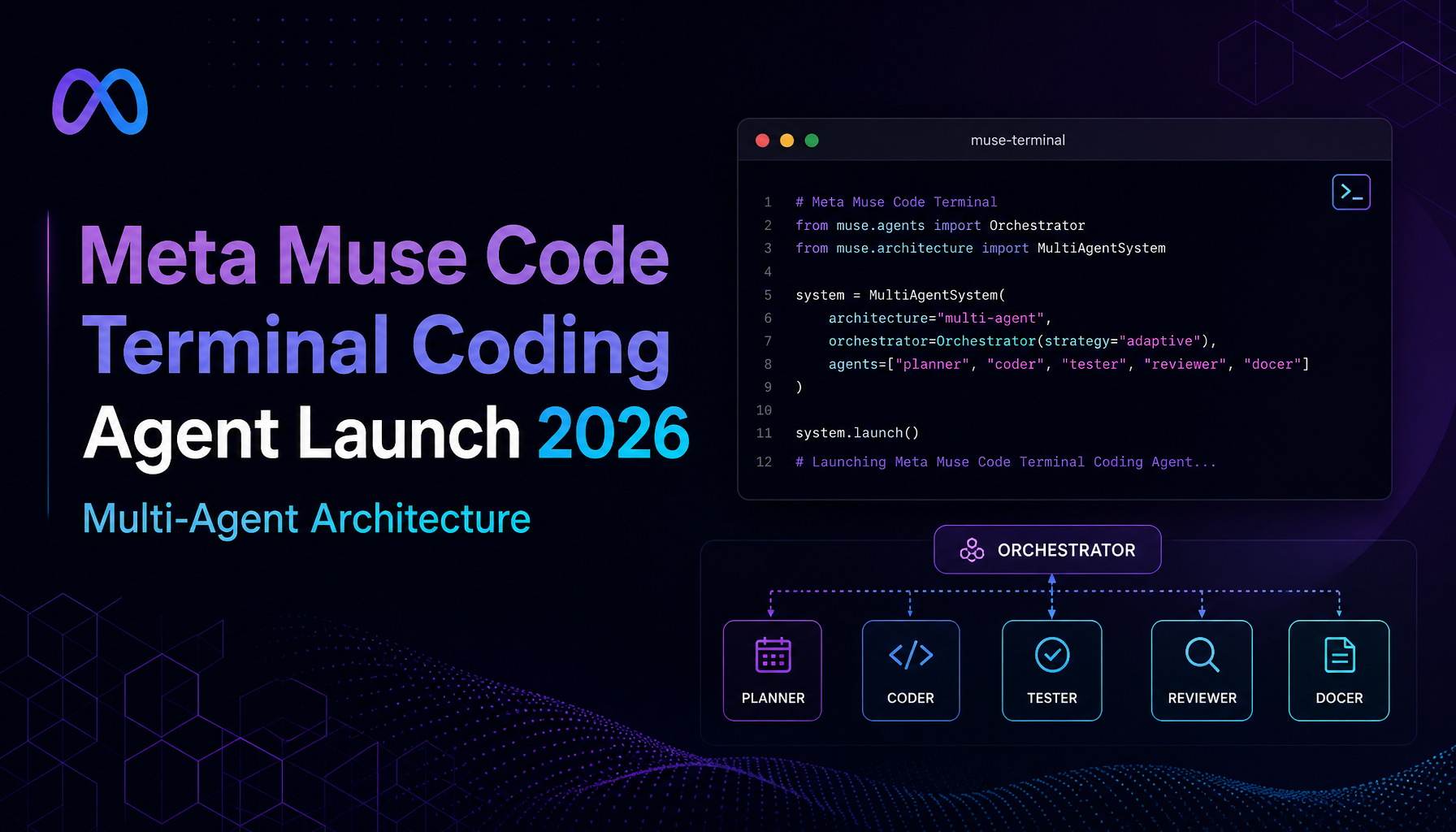
Meta launched Muse Code, its first terminal-based coding agent, on August 5, 2026. Powered by the new Muse Spark 1.2 model (co-trained with the agent harness itself), it brings multi-agent fan-out with isolated git worktrees, a 1M-token context window, full audit logging, and bundled design skills — all at $1.25/M input tokens. The coding agent market now has four major players: Claude Code, Codex CLI, Google Antigravity CLI, and Muse Code. Meta’s differentiation isn’t the model — it’s the agent architecture.
Introduction: Why This Matters Now
The coding agent market has been a three-horse race since early 2026: Anthropic’s Claude Code, OpenAI’s Codex CLI, and Google’s Antigravity CLI. On August 5, Meta joined the field with Muse Code — and the timing is telling.
Meta has spent the last year rebuilding its AI strategy under Alexandr Wang, who joined in June 2025 from Scale AI to lead Meta Superintelligence Labs (MSL) (Source: CNBC — Meta debuts first AI coding agent to take on Anthropic and OpenAI). The July 9 release of Muse Spark 1.1 was the opening move — a coding-optimized model without an agent to run it. Muse Code closes that gap, and it does so with an architectural philosophy that differs meaningfully from its competitors.
The stakes are real. Coding agents are the beachhead for agentic AI adoption in the enterprise. If Meta can capture developer mindshare here, it creates a path for the broader Muse model family into production environments where Llama 4 struggled to gain traction.
What Muse Code Actually Is
Muse Code is a terminal-based coding agent — you install it with one command, authenticate at dev.meta.ai, and start a session with muse in any project directory. It runs Muse Spark 1.2 under the hood, but the model is only half the story.
(Source: Meta AI Developers Blog — Meet Muse Spark 1.2 and Muse Code)
Architecture: Fan-Out by Default
The headline feature is automatic subagent fan-out. When you give Muse Code a batch of tasks, it spawns one write-capable child agent per task. Each child gets its own isolated git worktree under .muse/worktrees/ — so six parallel agents fixing six different bugs never collide on the same files. Your working copy stays untouched.
This isn’t a manual feature you configure. It’s the default behavior. The parent agent handles orchestration; you steer or stop any child from a single command center.
Full Audit Trail
Every session, every agent spawn, every tool call, every decision lands in a JSONL event log on disk at ~/.local/share/muse/sessions/. You can grep it with jq, replay it to understand what happened, and resume a crashed session from the last recorded step. No other coding agent exposes this level of observability by default.
Bundled Skills (Explicit-Invocation Only)
Muse Code ships with four built-in playbooks that fire only when you explicitly invoke them — the agent won’t auto-trigger /grill just because a design looks shaky:
| Skill | What It Does |
|---|---|
/taste |
Anti-slop checklist for UI generation |
/grilling |
Decision-forcing interview until the design holds up |
/grill-with-docs |
Same interview, writes decisions into project docs |
/plan |
Reads real files, surfaces key decisions, saves to .agents/plans/, stops for approval |
(Source: Meta AI Developers Blog)
Muse Spark 1.2: Co-Trained with the Harness
The model powering Muse Code is Muse Spark 1.2, and Meta made an unusual choice: they trained it inside the agent harness from day one.
Most coding agents bolt a model onto a harness after training. Meta put Muse Code in the training loop, so tool calls succeed and plans execute cleanly from the start. Crucially, they trained across multiple harnesses — the model generalizes to Claude Code, Codex CLI, or any other agent you’re already using.
Three performance characteristics stand out:
- 1M-token context window — holds dependency graphs, legacy monoliths, and thousands of files in one session
- Context compaction — for tasks that run past a single prompt, the agent compresses its working memory to maintain direction over hours
- Asynchronous parallel tool calls — work continues while results are still pending, rather than blocking on each call
On benchmarks, Muse Spark 1.2 is competitive with models in its class on TerminalBench, DeepSWE, Meta’s internal code bench, and GDPVal — though Meta hasn’t published SWE-Bench Verified scores for direct Claude Code comparison yet.
Pricing: The Contributor Tier Gambit
Meta is offering two pricing tiers:
| Tier | Pricing |
|---|---|
Contributor (muse-spark-1.2-contributor) |
Rate-limited by tokens in a 5-hour rolling window, not by request count. “More than 10x cheaper” than pay-as-you-go. Data may be used to improve models. |
Standard (muse-spark-1.2) |
$0.15/M cached input, $1.25/M input, $4.25/M output |
(Source: CNBC)
The contributor tier is a strategic move. At effectively ~$0.12/M tokens for heavy users, it undercuts Claude Code’s API pricing by an order of magnitude while simultaneously feeding Meta a training data flywheel. For comparison, DeepSeek V4 Flash — the budget champion — operates at $0.14/M input, making Muse Code’s contributor tier the cheapest coding agent on the market by a significant margin.
Competitive Landscape: Four Players, Four Philosophies
| Agent | Model | Pricing (input) | Key Differentiation |
|---|---|---|---|
| Claude Code | Claude Opus 5 / Sonnet 5 | ~$15/M (Opus 5) | Best-in-class reasoning, deep codebase understanding |
| Codex CLI | GPT-5.6 Sol | $2.50/M (cached) | OpenAI ecosystem, sandbox execution |
| Antigravity CLI | Gemini 2.5 Pro | $1.25/M (≤128K) | Google Cloud integration, Vertex AI |
| Muse Code | Muse Spark 1.2 | $1.25/M ($0.12/M contributor) | Multi-agent fan-out, audit logging, co-trained harness |
(Source: Claude Opus 5 benchmarks — The Agent Report, DeepSeek V4 Flash — The Agent Report)
Meta isn’t competing on raw model intelligence — Claude Opus 5 and GPT-5.6 Sol still lead on reasoning benchmarks. Instead, Muse Code competes on agent architecture:
- Multi-agent parallelism is native, not bolted on. Claude Code and Codex CLI can spawn subagents, but Muse Code’s isolated worktree approach prevents the collision problems that plague multi-agent coding workflows.
- Observability is a first-class feature. The JSONL event log is the kind of audit trail enterprises will demand before deploying coding agents at scale.
- Price is an order of magnitude lower than Claude Code at the contributor tier. For startups and indie developers, this changes the calculus entirely.
The risk: Muse Spark 1.2 needs to prove it can handle the complex, multi-file reasoning tasks where Claude Opus 5 excels. Until Meta publishes SWE-Bench Verified scores, the model’s ceiling is unproven.
What This Means for the Agent Ecosystem
Muse Code’s launch validates three trends we’ve been tracking at The Agent Report:
1. Coding Agents Are Now Table Stakes
Every major AI lab now has a coding agent. This isn’t optional anymore — if you’re building frontier models, you need a terminal agent to run them. The next battleground will be IDE integration (VS Code, JetBrains) and CI/CD pipelines, where coding agents move from developer tools to production infrastructure.
2. Agent Architecture Matters More Than Model Size
Meta didn’t try to build the smartest model. They built the smartest harness. Muse Spark 1.2 is a good-but-not-great coding model, but Muse Code’s fan-out architecture, worktree isolation, and audit logging make it more useful for multi-file, long-running tasks than a smarter model in a dumber harness. The lesson: in 2026, how your agent orchestrates work matters as much as what model it uses.
3. Price Compression Is Accelerating
The contributor tier at ~$0.12/M input tokens sets a new floor for coding agent pricing. Combined with DeepSeek V4 Flash at $0.14/M, we’re watching the cost of AI-assisted coding approach zero. This is excellent for adoption but brutal for business models built on per-token margins.
FAQ
Q: Is Muse Code better than Claude Code? Not yet — not on pure reasoning. Claude Opus 5 still leads on complex codebase understanding. But Muse Code’s multi-agent fan-out and audit logging solve real workflow problems that Claude Code doesn’t address natively. For teams doing large-scale refactors across multiple files, Muse Code might be more practical even if the model is weaker.
Q: Does Muse Code work with models other than Muse Spark? Muse Code is optimized for Muse Spark 1.2, but the model was co-trained across multiple harnesses — it works with Claude Code, Codex CLI, and other agents. The reverse (running Claude/GPT inside Muse Code) isn’t supported yet, though Meta hasn’t ruled it out.
Q: What’s the catch with the contributor tier? Your data may be used to improve Meta’s models. For open-source or personal projects, this is a fair trade. For enterprise codebases with proprietary logic, use the standard tier or request zero data retention (Meta is now accepting those requests).
Q: Is this open-source? No. Muse Code is a closed-source product running on Meta’s Model API. The JSONL event logs are local and you own them, but the agent and model are proprietary.
Q: How does this relate to Llama 4? It doesn’t. Muse Spark is a separate model family from Llama, developed by Meta Superintelligence Labs under Alexandr Wang. Llama 4 remains Meta’s open-weight offering; Muse Spark is their closed-source, API-only competitor to GPT and Claude.
Further Reading
- Meta AI Developers Blog — Meet Muse Spark 1.2 and Muse Code
- CNBC — Meta debuts first AI coding agent to take on Anthropic and OpenAI
- The Agent Report — Claude Opus 5 Benchmarks: Zero Prompt Injection, 88.3% on FrontierSWE
- The Agent Report — DeepSeek V4 Flash: The Economics of Agent-Scale Inference
- Meta Model API Documentation
- Meta Model Cookbook — Agent Fan-Out