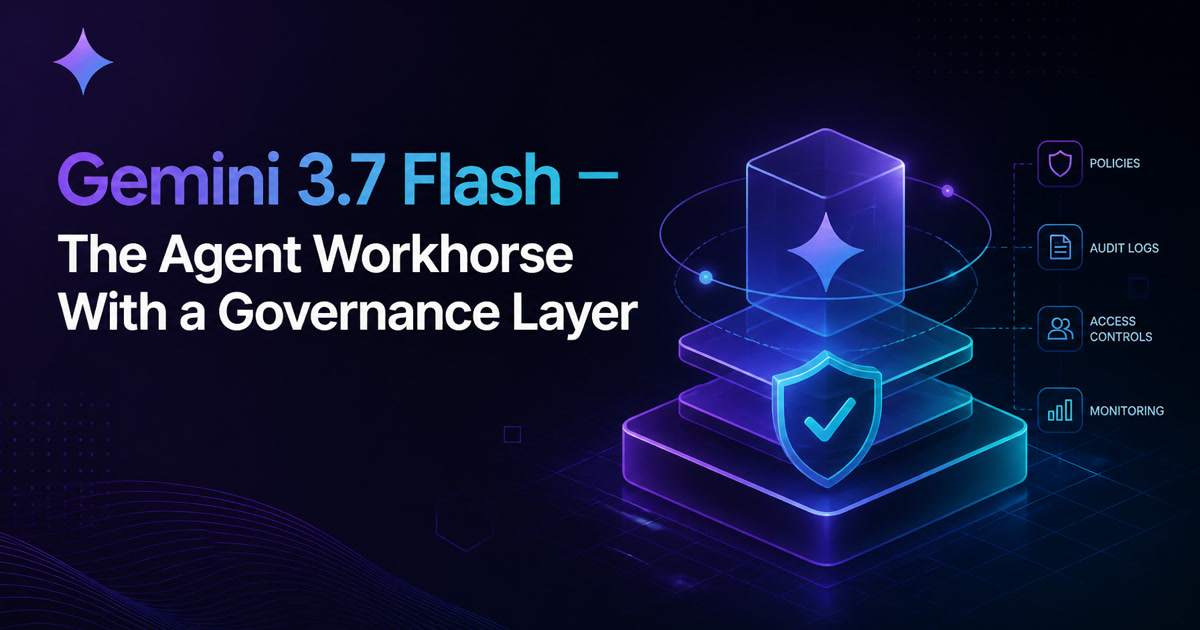
TL;DR — Google launched Gemini 3.7 Flash on 13 August 2026 as its “workhorse model for coding and agents,” priced at half of 3.6 Flash ($0.75/M input, $3.75/M output) through 31 December 2026. The same cycle added environment hooks, token budgets, cron triggers and a free tier to Managed Agents — a cheaper model plus a governance layer.
Introduction
On 13 August 2026 Google shipped Gemini 3.7 Flash; just over two weeks earlier, on 28 July, it expanded Managed Agents with hooks, budgets and schedules. Read together, they answer the question every builder asks: how do you take an autonomous agent from demo to production without hand-rolling the safety rails?
Pricing that resets the summer math
Gemini 3.7 Flash debuts at $0.75 per million input and $3.75 per million output tokens — exactly half the price of Gemini 3.6 Flash — through the end of 2026 (Source : Google — Introducing Gemini 3.7 Flash). From 1 January 2027, rates rise to $1.50 and $7.50. For an agent burning tens of millions of tokens a month across tool calls and context re-reads, halving the workhorse’s per-token cost separates a pilot from a line item. Google is effectively subsidising the migration: you have until year-end to move onto 3.7.
The benchmark delta is real, but narrow
The gains land exactly where builders feel pain — long-horizon coding and tool use. On DeepSWE v1.1, Gemini 3.7 Flash scores 65.3% against 3.6 Flash’s 49.0%; on FrontierCode 1.1 (Main) it posts 43.6% versus 34.4%; and it reaches 1588 Elo on the WebDev Arena (Source : Google Antigravity blog).
Google credits three capabilities: higher first-pass code accuracy, stronger multi-step planning, and more reliable tool calls (Source : Google Antigravity blog). That last one is the quiet headline: calling the right function with the right schema first time keeps errors from compounding across a 20-step run.
Availability: rollout is uneven — treat 3.7 as a canary
The model is exposed through Google Antigravity 2.0, the Gemini API, AI Studio and Google Cloud, under the model ID gemini-3.7-flash (Source : Google Antigravity blog).
But third-party docs flag a nuance: the public Gemini API surface — changelog, pricing and rate limits — has not fully converged on 3.7 yet, and availability is uneven across the Gemini API, AI Studio, Vertex and the Agent Platform (Source : AgentPedia Developer Guide). The practical recommendation: evaluate 3.7 in shadow traffic or behind a feature flag, and keep 3.6 Flash pinned as a rollback until the docs and your own telemetry agree.
Managed Agents: the control plane update
The strategic half landed on 28 July 2026, in the antigravity-preview-05-2026 update. Gemini 3.6 Flash is the default model for Managed Agents; the point is the control plane that wraps around it (Source : Google — Expanding Managed Agents).
Environment hooks. A .agents/hooks.json file defines scripts that run pre- and post-tool-call, matched by regex, and executed either as command handlers inside the sandbox or as HTTP handlers pointing at your own services (Source : Creative AI News). That’s a general-purpose interception layer: validate a shell command before it runs, block a file write, lint generated code, append to an audit log (Source : Google docs custom agents). You can now wrap guardrails, budgets and schedules around an agent without writing your own orchestration layer.
Budget caps. max_total_tokens caps spend per run. When the budget is exhausted, the agent stops with an “incomplete” status and its state preserved, so the run is resumable rather than lost (Source : Creative AI News).
Scheduled triggers and inspection. Cron triggers run agents on a schedule with a persisted sandbox, and a new Environments API inspects those sandbox sessions (Source : Google — Expanding Managed Agents).
Free tier. Managed Agents now has a free tier for API-key projects, removing the “can I even afford to test this” barrier (Source : Creative AI News).
What it means for builders
Hooks, budgets and schedules are the governance layer that makes autonomous agents deployable in production. A hook that vetoes a shell command, a token cap that bounds worst-case cost, and a resumable state on budget exhaustion are the first things a serious team builds when an agent leaves the sandbox — and Google is now shipping them as API features.
Combine that with a model at half price, and the economics shift twice: the marginal cost of an agent run drops for the rest of 2026, and the entry barrier falls for everyone else via the free tier. The uneven rollout shows the control plane and the model move on different timelines — but the direction is what matters.
FAQ
Is Gemini 3.7 Flash cheaper than 3.6 Flash? Yes — $0.75/$3.75 per million tokens through 31 December 2026, half of 3.6 Flash, rising to $1.50/$7.50 from 1 January 2027 (Source : Google — Introducing Gemini 3.7 Flash).
Where can I call Gemini 3.7 Flash today?
Via Google Antigravity 2.0, the Gemini API, AI Studio and Google Cloud, with model ID gemini-3.7-flash. Note that API documentation and rate limits have not fully converged everywhere yet (Source : AgentPedia Developer Guide).
What do Managed Agents hooks actually let me do? Run scripts before or after any tool call — matched by regex, executed in-sandbox or as an HTTP call to your service — to validate commands, block writes, lint output or log an audit trail (Source : Google docs custom agents).
What happens when an agent hits its token budget? The run stops with an “incomplete” status and its state preserved, so you can resume rather than restart from zero (Source : Creative AI News).
Further Reading
- Google — Introducing Gemini 3.7 Flash
- Google Antigravity blog — Gemini 3.7 Flash in Google Antigravity
- Google — Expanding Managed Agents
- Google AI — Custom Agents (Managed Agents) docs
- AgentPedia — Gemini 3.7 Flash Developer Guide
- Creative AI News — Gemini Agents: Hooks, Budget, Free Tier
— The Agent Report