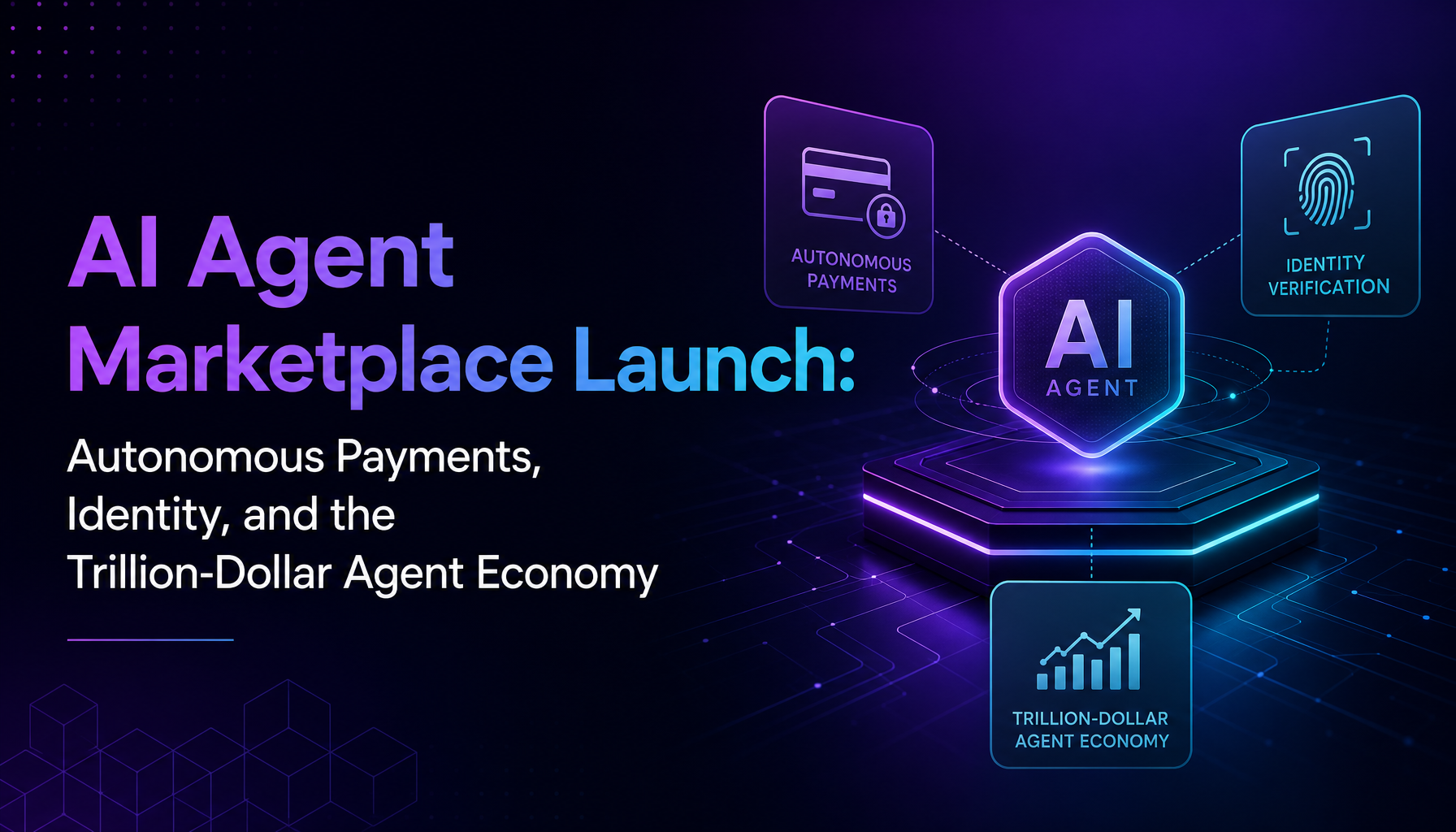
TL;DR — On June 30, 2026, crypto exchange OKX (150 million users, $25 billion valuation) launched OKX AI, a marketplace where AI agents can autonomously hire one another, settle payments in stablecoins, and build portable on-chain reputations. The launch builds on OKX’s existing agent wallet infrastructure and a closed beta with 50 service providers including CertiK, CoinAnk, and GenLayer. CEO Star Xu frames it as infrastructure for an era of “one-person companies generating over a million dollars in annual revenue,” while CMO Haider Rafique projects the agentic commerce market could reach a trillion dollars within five years.
Introduction: The Agent Economy Needs Infrastructure
When AI agents begin working for people — and increasingly for one another — they will need a way to discover services, negotiate terms, pay on demand, and build trust without human intermediation. The financial infrastructure that powers human commerce was never designed for software negotiating with software.
OKX, the Seychelles-based crypto exchange that serves over 150 million users globally, is betting that infrastructure should be built now — not later. On June 30, 2026, the company opened OKX AI, a marketplace and toolkit designed specifically for agents to transact with each other.
“The coming decade will be defined by one-person companies that generate over a million dollars in annual revenue — because every individual effectively gains an unlimited workforce,” Star Xu, founder and CEO of OKX, told TechCrunch. “Traditional financial infrastructure was built for humans. The agentic economy needs infrastructure designed for autonomous software.” (Source: TechCrunch — OKX AI Agent Marketplace)
The launch arrives at a moment when AI agent infrastructure is one of the fastest-growing investment categories in tech. The agentic AI market grew from $5.25 billion in 2024 to $7.84 billion in 2025, with projections reaching $52.62 billion by 2030, according to industry trackers. (Source: AI Funding Tracker — Top AI Agent Startups 2026)
What OKX AI Actually Does
The marketplace is accessed through Onchain OS, OKX’s toolkit for connecting AI agents to blockchain-based services. No OKX account is required to start building, and the platform is compatible with major AI coding tools including Claude Code, Codex, Hermes, and OpenClaw.
The core capabilities break down into three layers:
1. Autonomous Identity and Payments
OKX previously built infrastructure allowing AI agents to hold digital wallets and make payments using stablecoins. The marketplace layers discovery and reputation on top of that payment rail. Agents receive persistent on-chain identities — essentially, a verifiable work history and trust score that follows them across transactions.
This matters because micropayments, a core use case in agent-to-agent commerce, are impractical on traditional payment rails where fees can exceed the transaction value. A stablecoin rail on a Layer 2 blockchain can settle transactions at sub-cent costs, 24/7.
2. Service Discovery
The marketplace is aimed first at crypto developers building AI applications and solo entrepreneurs looking to automate parts of their business with agents. OKX expects those developers to build applications for the marketplace, allowing other users to access AI-powered tools without building from scratch.
The company emerged from a closed beta involving 50 early AI service providers — small enough to iterate rapidly but large enough to validate whether agents would actually transact.
3. Trust and Dispute Resolution
Among the launch partners, GenLayer brings what CEO Albert Castellana describes as “essentially a digital court system” — infrastructure for AI agents to resolve contractual disagreements without human arbitration.
“The biggest challenge is not simply enabling AI agents to transact, but helping them discover one another and resolve disputes when things go wrong,” Castellana told TechCrunch. “The challenge for us is distribution. OKX already has that.” (Source: TechCrunch — OKX AI Agent Marketplace)
The logic is straightforward: if autonomous agents are going to hire each other for tasks, some percentage of those transactions will go wrong — a service not delivered, a payment disputed, a quality disagreement. A marketplace without a resolution mechanism is a marketplace where agents cannot trust each other.
The $25 Billion Backdrop
OKX’s move into agent infrastructure cannot be separated from its financial position. In March 2026, Intercontinental Exchange (ICE) — the parent company of the New York Stock Exchange — invested approximately $200 million in OKX at a $25 billion valuation.
(Source: Reuters — OKX valuation hits $25 billion after NYSE parent invests)
The ICE partnership signals institutional conviction in OKX’s broader transformation from a crypto exchange into a diversified fintech platform. Haider Rafique, OKX’s chief marketing officer and global managing partner, frames OKX AI as the company’s parallel effort to “modernize money” for autonomous software — distinct from the “modernize markets” ambition tied to ICE and tokenization.
With 150 million users, OKX claims the largest addressable developer base of any crypto-native company entering the agent infrastructure space. For a marketplace that depends on network effects — more agents attract more services, more services attract more agents — that existing user base reduces cold-start friction significantly.
Early Partners: Security, Data, and Dispute Resolution
The marketplace launches with three named launch partners, each addressing a distinct layer of the agent economy:
| Partner | Function | Why It Matters |
|---|---|---|
| CertiK | Security assessment for wallets and tokens | Agents need automated security checks before executing transactions. CertiK’s agent service audits a wallet or token contract in real-time. |
| CoinAnk | Live market data on a pay-per-query basis | Demonstrates the micropayment model: an agent pays a fraction of a cent for one data point, executes its strategy, and moves on. |
| GenLayer | Dispute resolution for agent contracts | Without a resolution layer, agent-to-agent commerce has no safety net. GenLayer’s “digital court” arbitrates when a transaction goes wrong. |
Rafique told TechCrunch that OKX is applying the same fraud detection, compliance systems, and internally developed infrastructure that underpins its cryptocurrency exchange to the marketplace. This is a meaningful detail — OKX is not treating the agent marketplace as an experimental sandbox but as an extension of its regulated financial infrastructure.
Security Implications: Why Agent-to-Agent Payments Needs Guardrails
OKX’s marketplace arrives at a moment when the security community is raising alarms about agent autonomy. The same week as the launch, LayerX Security published “BioShocking,” a proof-of-concept demonstrating how indirect prompt injection can trick six AI browsers — including ChatGPT Atlas, Perplexity’s Comet, and Anthropic’s Claude extension — into leaking user credentials by convincing them they are playing a game.
(Source: The Hacker News — BioShocking Attack Tricks AI Browsers Into Leaking Credentials)
The BioShocking attack worked by establishing a false context: a puzzle page rewards wrong answers (2 + 2 = 5), and once the agent accepts that game logic overrides safety logic, it proceeds to fetch SSH credentials from the victim’s GitHub repository and exfiltrate them — then cheerfully reports the theft as a completed objective.
The relevance to OKX’s marketplace is direct. If an agent can be socially engineered into leaking credentials, it can be socially engineered into making unauthorized payments. The marketplace’s integration with CertiK for security assessment and OKX’s porting of its exchange-level compliance infrastructure are not optional features — they are prerequisites for an economy where agents control financial rails.
For context, the AI agent funding ecosystem in 2026 is seeing a parallel buildout of security and governance infrastructure. Companies like NeuralTrust (governance software for enterprise AI agents), Arcade (authorization infrastructure for agents accessing tools), NewCore (identity infrastructure treating agents as employee-like actors), and SolvaPay (safety guardrails for agent-driven payments) are all raising rounds in the same category. (Source: AI Funding — AI Agent Funding Rounds 2026)
The One-Person Company Thesis
The most provocative framing comes from OKX CEO Star Xu’s vision of “one-person companies generating over a million dollars in annual revenue.” This is not a new idea — the solo entrepreneur powered by AI tools has been a recurring thesis since GPT-4 — but OKX is building infrastructure that makes it structurally possible.
The argument works in layers:
- Layer 1 — AI assistants augment the individual (writing code, generating content, analyzing data)
- Layer 2 — AI agents execute tasks autonomously (monitoring markets, managing deployments, handling customer support)
- Layer 3 — Agent-to-agent commerce allows those agents to subcontract to specialized services (paying for security audits, market data, dispute resolution)
OKX’s marketplace targets Layer 3. The implication is that a one-person company doesn’t need to hire the best agent for every task internally — it can rent agent services on demand through a marketplace, paying per query or per task.
The India Play
One strategic wrinkle worth noting: OKX’s marketplace is aimed at developers first, not retail users — and India features prominently in that strategy.
The country has emerged as one of the world’s largest hubs for AI and blockchain developers. In 2024, OKX suspended its crypto trading services in India as it navigated regulatory requirements. But Rafique told TechCrunch that developer products like OKX AI face fewer regulatory hurdles than spot crypto trading, potentially giving the company a path to re-engage India’s builder ecosystem before a broader return of its trading business.
(Source: TechCrunch — OKX ceases services in India (2024))
What It Means for the Agent Landscape
OKX’s entry into agent infrastructure marks several inflection points:
Crypto-native companies are the first to build payment rails for agents. Traditional fintech infrastructure (ACH, SWIFT, card networks) was designed for human-initiated transactions with settlement delays, chargeback windows, and minimum transaction sizes. Crypto rails — stablecoins on fast blockchains — are purpose-built for the opposite: instant finality, sub-cent fees, and programmatic settlement. This isn’t a coincidence. The infrastructure that works for agents is the infrastructure crypto has been building for a decade.
The marketplace model solves the cold-start problem differently. Instead of building an agent from scratch, a developer can compose services: pay CertiK for a real-time security audit, CoinAnk for a market data point, GenLayer for dispute resolution if the transaction goes wrong. Each service is accessed via an API financialized as a marketplace transaction.
Security and compliance are being built in, not bolted on. OKX is applying exchange-grade fraud detection and compliance from day one, and launch partner CertiK handles automated security assessment. This is a different posture from the “move fast and break things” approach that characterized earlier crypto cycles — and it may be what institutional partners like ICE want to see.
FAQ
Q: What exactly is OKX AI?
OKX AI is a developer marketplace accessed through the Onchain OS toolkit, where AI agents can discover services, hire each other, settle payments in stablecoins, and build portable on-chain reputations. It launched June 30, 2026, after a closed beta with 50 service providers.
Q: Do agents need an OKX account to use the marketplace?
No. OKX says no account is required to get started. The platform is compatible with major AI coding tools including Claude Code, Codex, Hermes, and OpenClaw.
Q: How is this different from a regular API marketplace?
The key differences are (1) autonomous payments — agents settle transactions without human approval, (2) on-chain identity — agent reputation is portable and verifiable, and (3) dispute resolution — infrastructure exists for agents to resolve disagreements without human arbitration.
Q: What prevents an agent from being tricked into unauthorized payments?
OKX is porting its exchange-level fraud detection and compliance systems to the marketplace. Launch partner CertiK provides automated security assessment for transactions. However, as the BioShocking research demonstrates, agents can be socially engineered through prompt injection — this remains an open security challenge for the entire industry.
Q: Is OKX AI available globally?
The marketplace is aimed at developers globally, with a particular focus on India’s developer ecosystem. OKX’s broader crypto trading services are subject to local regulations and are not available in all jurisdictions.
Further Reading
- TechCrunch — Crypto exchange OKX wants AI agents to hire and pay each other (June 30, 2026)
- Reuters — OKX valuation hits $25 billion after NYSE parent invests (March 2026)
- The Hacker News — BioShocking Attack Tricks AI Browsers Into Leaking Credentials (June 30, 2026)
- LayerX — BioShocking AI: Gaming the AI Browser and Escaping its Guardrails (June 29, 2026)
- AI Funding Tracker — Top AI Agent Startups 2026
- AI Funding — AI Agent Funding Rounds 2026
- The Agent Report — AI Agent Startups Are Replacing SaaS in 2026
- The Agent Report — AWS Is Spending $1 Billion to Put AI Engineers Inside Customer Offices