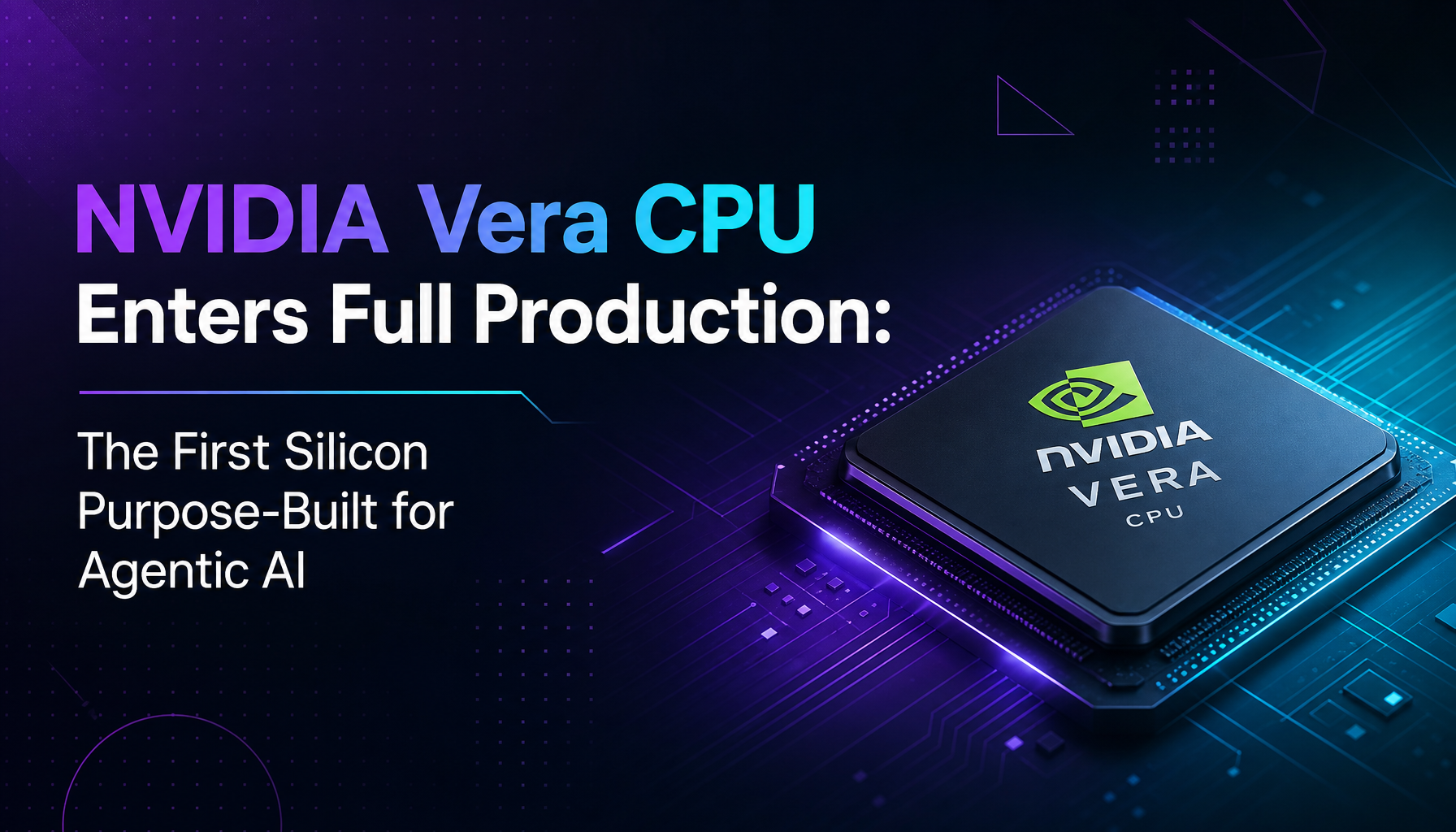
TL;DR — NVIDIA’s Vera CPU, announced at GTC 2026 in March, entered full production on June 22 at ISC High Performance 2026 in Hamburg. This is the first processor architected from the ground up for agentic AI workloads — not a repurposed general-purpose CPU. Los Alamos National Laboratory will deploy ~1,150 Vera CPUs across three next-generation supercomputers (Mission, Vision, Veritas). CEO Jensen Huang declared that “the CPU is no longer simply supporting the model; it’s driving it.” With AI agent software spending projected to hit $206.5 billion in 2026 (Gartner, +139% YoY), the hardware layer is now catching up to the software paradigm shift.
Introduction: When Software Outruns Silicon
For the past three years, the AI agent ecosystem has been building on borrowed hardware. Every autonomous coding agent, every multi-step reasoning pipeline, every MCP server orchestration — they all run on CPUs designed for web servers and database queries, not for the unique computational patterns of agentic workloads.
That era ended on June 22, 2026.
At ISC High Performance 2026 in Hamburg, NVIDIA confirmed that the Vera CPU — first teased at GTC in March — has entered full production. Unlike every server CPU that came before it, Vera was not designed to serve web pages, run virtual machines, or process batch jobs. It was designed for one thing: orchestrating AI agents.
The timing is not accidental. Gartner’s latest forecast puts AI agent software spending at $206.5 billion in 2026, up from $86.4 billion in 2025 — a 139% single-year jump (Source: Gartner — Autonomous Business and AI Layoffs May Create Budget Room But Do Not Deliver Returns). The projection climbs to $376.3 billion in 2027. The software spending is already there. The hardware is now arriving.
Vera CPU: What’s Under the Hood
Vera is a clean-sheet CPU design built on ARM v9 architecture, fabricated on a custom process node. Here are the specifications that matter for agent workloads:
| Specification | Vera CPU | Context |
|---|---|---|
| Cores | 88 custom Olympus cores | Arm v9, purpose-designed |
| Threads | 176 (2 per core) | SMT-enabled |
| L3 Cache | 162 MB | Shared across all cores |
| Memory bandwidth per core | 14 GB/s | ~3× traditional server CPUs |
| Target workload | Agent orchestration + RL | Control-heavy, latency-sensitive |
(Source: NVIDIA — Vera CPU Product Page; NVIDIA Newsroom — Vera Launch Announcement)
The 14 GB/s per-core bandwidth figure is the number that matters most. Agentic workloads are not throughput-bound in the traditional sense — they are coordination-bound. An AI agent pipeline might spawn 40 sub-agents, each making API calls, reading context, and returning partial results. The CPU’s job is to manage thousands of these lightweight, high-frequency interactions without adding latency.
Why Agentic AI Needs Different Silicon
The computational profile of agentic AI is fundamentally different from both traditional serving and training workloads. Understanding this difference explains why Vera exists.
1. Latency sensitivity, not throughput
A batch inference job cares about tokens-per-second. An agent pipeline cares about end-to-end task completion time, which is dominated by coordination overhead — context switching between tool calls, parsing outputs, routing to the next agent. Every millisecond the CPU spends on overhead is a millisecond the GPU sits idle.
2. High context-switching density
An MCP server handling 50 concurrent agent sessions is performing continuous context switches — loading tool schemas, validating inputs, serializing outputs. Traditional server CPUs optimize for long-running homogeneous workloads. Agent orchestration is the opposite: thousands of short, heterogeneous operations per second.
3. Reinforcement learning on the control plane
Agentic systems increasingly use RL-based self-improvement loops (DSPy, GEPA, textual gradients). These loops run on the CPU and involve frequent model calls, gradient computation, and prompt mutation — a workload that looks nothing like a database query or a web request.
4. Memory bandwidth per operation, not per batch
Traditional HPC optimizes for bandwidth across large contiguous data transfers. Agent orchestration touches many small memory regions (prompt fragments, tool outputs, conversation state) scattered across cache lines. The 14 GB/s per-core figure is designed precisely for this access pattern.
As Jensen Huang put it at the production announcement: “Vera is arriving at a turning point for AI. As intelligence becomes agentic — capable of reasoning and acting — the importance of the systems orchestrating that work is elevated. The CPU is no longer simply supporting the model; it’s driving it.” (Source: Data Center Dynamics — NVIDIA Vera CPU Enters Full Production)
Los Alamos: The Flagship Deployment
The most significant validation of Vera’s architecture comes from Los Alamos National Laboratory (LANL), which announced a three-supercomputer deployment at ISC 2026.
The three systems — named Mission, Vision, and Veritas — represent a generational refresh of LANL’s computing infrastructure. Veritas, the most ambitious of the three, will feature approximately 1,150 standalone NVIDIA Vera CPUs complementing Vera Rubin GPU nodes.
This is not a GPU cluster with a few CPUs for housekeeping. The Vera CPUs in Veritas are deployed as primary compute resources, not ancillary controllers. They will serve the Laboratory Directed Research and Development (LDRD) program, with a specific mandate to accelerate agentic AI for scientific discovery.
(Source: NVIDIA Blog — NVIDIA Vera CPU Opens the Way for Agentic Scientific AI at Los Alamos National Laboratory)
What “agentic scientific AI” actually means
LANL’s use case is instructive. Scientific computing at national labs involves:
- Multi-physics simulations where different models must coordinate (fluid dynamics → structural analysis → thermal modeling)
- Automated experiment design where AI agents propose hypotheses, design simulations, and interpret results in a closed loop
- Literature-aware research agents that cross-reference simulation outputs against published findings
All of these are agentic workflows. They involve orchestration, not just computation. Vera is the first CPU that treats this orchestration as a first-class workload.
The Broader Ecosystem: Who Else Is Deploying Vera?
Los Alamos is the marquee customer, but it’s not alone.
Lawrence Berkeley National Laboratory (NERSC) will deploy the Doudna supercomputer, also based on Vera Rubin architecture. NERSC serves over 10,000 scientific users annually across materials science, climate modeling, and genomics — all domains where agentic AI pipelines are gaining traction (Source: Stock Titan — NVIDIA Vera Rubin Delivers World-Class Supercomputers for Science).
Major OEMs including HPE, Dell, and Lenovo have committed to shipping Vera Rubin NVL4 racks starting in Q4 2026. The NVL4 form factor — which tightly couples Vera CPUs with Rubin GPUs in a single rack — is designed for the co-location that agentic workloads demand.
At ISC 2026, partners including DDN, GIGABYTE, and HPE showcased end-to-end infrastructure built around Vera. The messaging was consistent: this is not a GPU launch with a CPU footnote. The CPU is the story.
(Source: HPCwire — GIGABYTE Connects AI, HPC, and Next-Gen Infrastructure at ISC 2026; DDN — DDN Unveils Next-Generation AI HPC Data Intelligence Innovations at ISC 2026)
Market Context: The $206.5 Billion Signal
The hardware pivot makes sense when you look at where the money is going.
Gartner’s May 2026 forecast pegged AI agent software spending at $206.5 billion for 2026 — a 139% increase over 2025’s $86.4 billion. The trajectory accelerates to $376.3 billion in 2027.
But here’s the nuance Gartner added: “autonomous business and AI layoffs may create budget room but do not deliver returns.” The spending is real, but the ROI is still unproven. Enterprises are buying agent software faster than they can integrate it — and integration means infrastructure.
Deloitte’s 2026 Tech Trends report put it more bluntly: “Processes designed for human workers don’t work for agents.” The entire stack — from CPU architecture to data center topology — needs rethinking (Source: Deloitte — Tech Trends 2026).
Vera is NVIDIA’s answer to the infrastructure question. It’s also a competitive move. AMD’s EPYC Turin and Intel’s Granite Rapids are excellent server CPUs, but neither was designed for agent orchestration as a primary workload. By defining a new CPU category — the “agentic compute CPU” — NVIDIA is creating a market segment where it has no direct competitor.
What This Means for AI Agent Developers
For the developers building agent frameworks, tools, and platforms, Vera’s production entry has several downstream implications:
1. Agent orchestration becomes a hardware-specialized workload
Today, running a 50-agent pipeline on a standard Xeon or EPYC means accepting that ~40% of CPU cycles go to overhead the chip wasn’t optimized for. On Vera, that overhead is the design target. For agent platforms (LangChain, CrewAI, Hermes, AutoGen), this means lower latency and higher throughput without software changes.
2. Self-improving agents get a hardware turbo
Techniques like DSPy, textual gradients, and genetic prompt optimization run their optimization loops on CPU. A CPU with 3× the per-core memory bandwidth directly accelerates the rate at which agents can self-improve.
3. Scientific computing leads, enterprise follows
The LANL deployment is a pattern that will repeat in pharmaceuticals, materials science, finance, and logistics — any industry where multi-agent scientific workflows already exist. The national labs are serving as the proving ground for hardware that will reach the enterprise in 2027-2028.
4. The CPU-GPU balance shifts
For the past decade, AI infrastructure conversations have been GPU-centric. Vera signals that the pendulum is swinging back — not away from GPUs, but toward architectures where the CPU is an equal partner in the agent orchestration plane.
FAQ
Q: Is Vera available for purchase today, or is this a paper launch?
A: Full production means the silicon is being manufactured and validated. OEM systems (HPE, Dell, Lenovo) will ship Vera Rubin NVL4 racks starting Q4 2026. The Los Alamos deployment is a multi-year rollout beginning in 2027.
Q: How does Vera compare to AMD EPYC or Intel Xeon for non-agent workloads?
A: Vera is purpose-built. For traditional server workloads (web serving, databases, virtualization), EPYC and Xeon remain competitive or superior. Vera’s advantage is specific to agent orchestration, reinforcement learning loops, and high-concurrency context switching. It’s not a general-purpose replacement.
Q: Does my agent framework need to be rewritten for Vera?
A: No. Vera runs standard ARM v9 Linux. Any agent framework compiled for ARM will run. The performance gains come from the microarchitecture — larger caches, higher per-core bandwidth, optimized branch prediction for coordination-heavy code — not from a new ISA or API.
Q: What’s the relationship between Vera CPU and Vera Rubin GPU?
A: Vera is the CPU; Vera Rubin is the GPU. They’re designed as a paired architecture (the Vera Rubin platform). The NVL4 rack form factor tightly couples them, with Vera CPUs handling orchestration and Rubin GPUs handling model inference and training.
Q: Is this the end of x86 for AI infrastructure?
A: Not immediately. ARM is gaining ground in the data center (AWS Graviton, Ampere, now Vera), but x86 has a massive installed base and ecosystem. Vera creates a new category — agentic compute — that doesn’t directly displace x86 but defines a workload where ARM has a clean-sheet advantage.
Further Reading
- NVIDIA Launches Vera CPU, Purpose-Built for Agentic AI — Official announcement (March 2026)
- NVIDIA Vera CPU Product Page — Technical specifications
- Everything You Need to Know About the NVIDIA Vera CPU — Radiant, June 5, 2026
- NVIDIA Vera CPU Opens the Way for Agentic Scientific AI at Los Alamos — NVIDIA Blog, June 22, 2026
- NVIDIA Gets All Agentic About Supercomputing for Scientific Research — The Register, June 22, 2026
- NVIDIA Vera CPU Enters Full Production, Pitched at Agentic AI Workloads — Data Center Dynamics, June 22, 2026
- AI Spending Forecasts 2026: Gartner, IDC & Stanford — Digital Applied, June 12, 2026
- Gartner: AI Agent Software Spend to Hit $206.5B in 2026 — Gartner, May 5, 2026
The Agent Report covers the intersection of AI agents, infrastructure, and the companies building the autonomous future. For daily updates, follow our latest coverage.