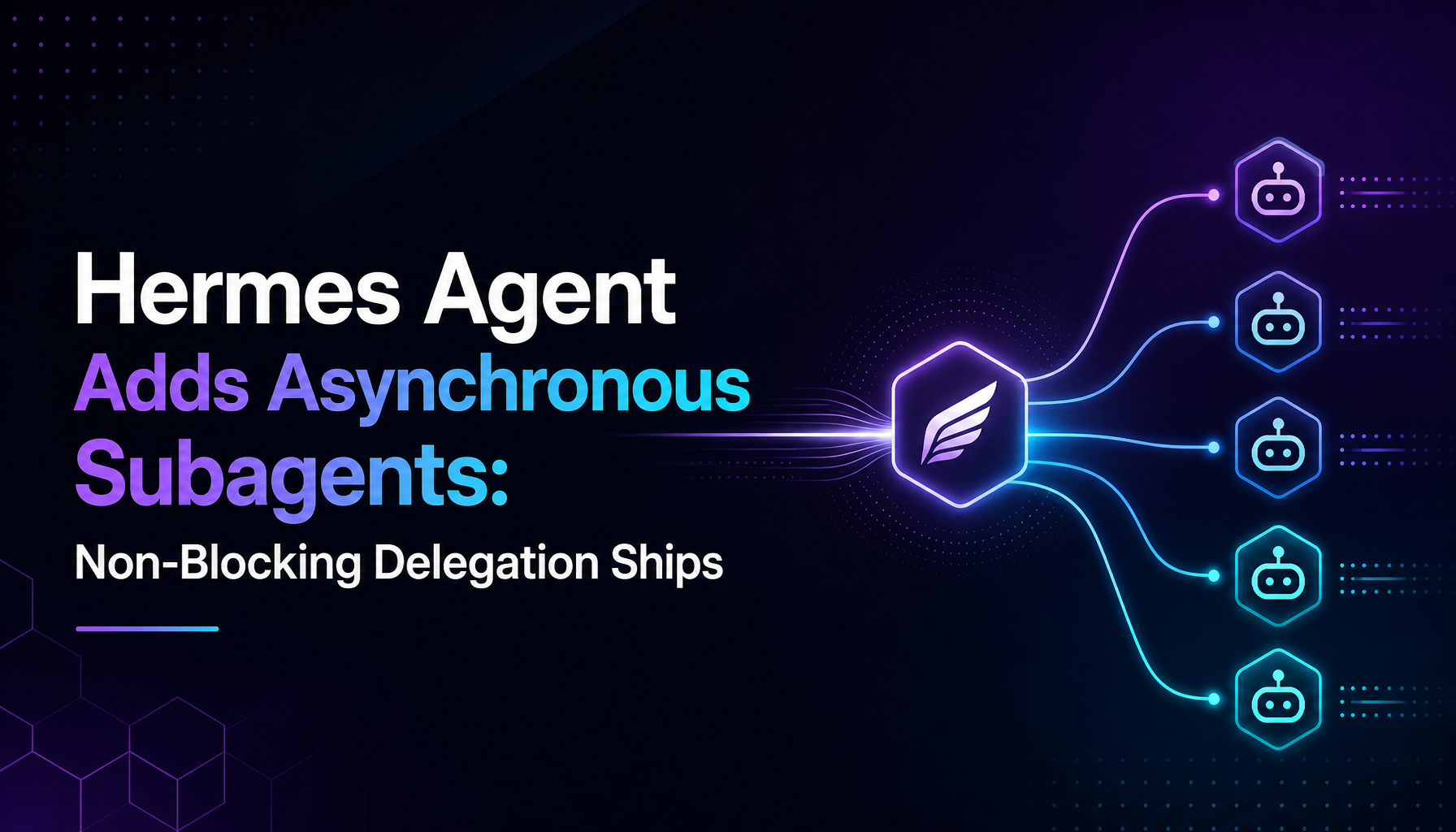
TL;DR: Hermes Agent now supports non-blocking subagent delegation. The new async_delegation toolset spawns background agents and returns a task_id immediately — parent chats stay free while children run. Six lifecycle tools give you full control: spawn, check, steer, collect, cancel, and list. Run hermes update to enable it.
The Problem: Synchronous Delegation Froze the Parent
Since Hermes Agent first shipped subagent delegation, the delegate_task tool worked synchronously: the parent agent blocked inside the tool call until every spawned child completed. For a single short task, this was fine. For parallel long-running work — market scans, codebase refactors, multi-source research — it froze the parent chat entirely.
You couldn’t continue drafting, steer runs interactively, or monitor progress without waiting. Workflows that relied on concurrent background tasks were cumbersome.
What Changed: async_delegation
On June 16, Nous Research shipped the async_delegation toolset (tracked in GitHub issue #5586). Background agents now run as in-process threads and reuse the existing AIAgent machinery, credentials, and toolsets. The parent receives a task_id immediately and stays responsive.
The full async lifecycle API:
delegate_task_async— spawn a background agent, returnstask_idimmediatelycheck_task— non-blocking status plus recent outputsteer_task— inject a message into a running task mid-flightcollect_task— block until done, return full resultcancel_task— stop a running tasklist_tasks— list all async tasks in the session
Here’s what the shift looks like in practice:
# Before (synchronous): parent blocked until all children finished
delegate_task(tasks=[
    {"goal": "Research topic A", "toolsets": ["web"]},
    {"goal": "Fix the build",   "toolsets": ["terminal", "file"]},
])

# After (async): parent stays free
t1 = delegate_task_async(goal="Research topic A")
t2 = delegate_task_async(goal="Research topic B")

check_task(t1["task_id"])                       # status, no blocking
steer_task(t2["task_id"], "Use post-2024 sources only")
results = [collect_task(t["task_id"]) for t in (t1, t2)]
What Stays the Same
Subagents remain strictly isolated — each gets its own conversation, terminal session, and toolset. Only the final summary enters the parent’s context window. Credential inheritance and config.yaml cost-tier routing work identically for both sync and async paths.
Limitations to Watch
Async subagents are single-session only — they run in-process and are not durable across restarts or new chat turns. Cross-turn persistence is tracked separately under ACP #4949. Also, subagents inherit the parent’s credentials, so review least-privilege rules before delegating sensitive tasks.
Getting Started
Existing users enable the feature with a single command:
hermes update
Then audit config.yaml for cost routing, tune delegation.max_concurrent_children per your host resources, and update team runbooks with the new task lifecycle commands. The Hermes TUI already exposes an /agents overlay (aliased /tasks) showing running and finished subagents.
This feature transforms Hermes Agent from a linear task executor into a true parallel orchestration runtime — the kind of capability that separates chat wrappers from agent operating systems.
Sources: Teknium on X, Nous Research, Hermes Agent docs, GitHub issue #5586