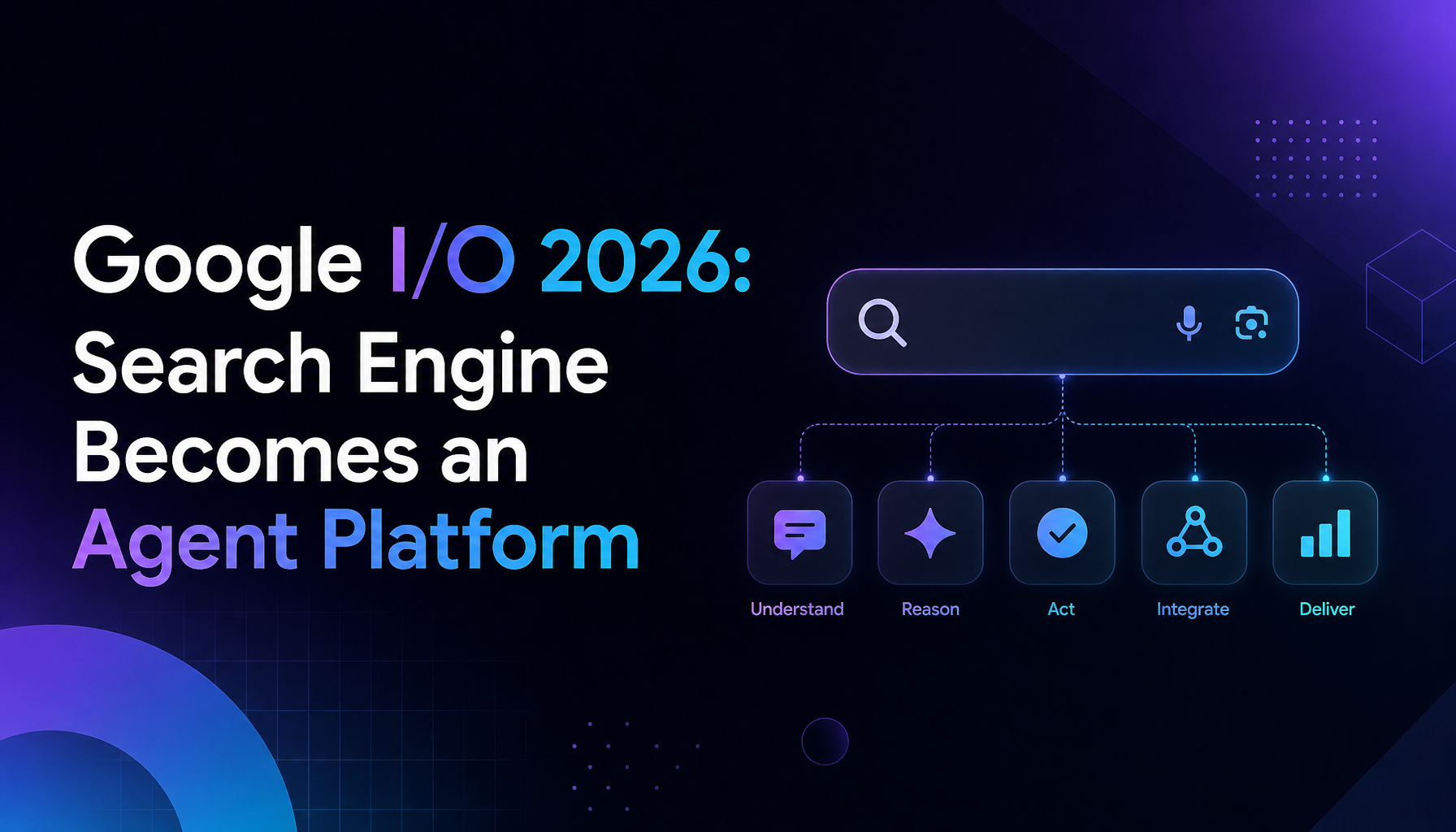
TL;DR — At Google I/O 2026 (May 19), Google announced that Search is no longer just a retrieval engine — it’s an AI agent platform. Users can now create, customize, and manage multiple AI agents directly in Search “just by asking a question,” backed by Gemini Spark, a 24/7 personal AI agent. Google’s goal for 2026 is to put agents at the forefront of Search, Gmail, YouTube, Docs, and Chrome. With billions of daily searches, this represents the largest deployment of agentic AI ever attempted — and a fundamentally different strategy from OpenAI’s standalone agent approach.
The Announcement
At Google I/O 2026, the company made its ambition unmistakable: “put AI agents at the forefront of all its biggest services: Search, Gmail, YouTube, Docs, and the Chrome browser” (Source: Google Blog — All Our Announcements). The flagship reveal was Search agents — a capability that lets users summon, customize, and manage AI agents directly from the search interface.
“We’re entering the era of Search agents, where you can easily create, customize and manage multiple AI agents for your many tasks, right in Search.” — Google Blog, ‘100 things’ (Source: Google Blog — Search I/O 2026)
Alongside this, Google introduced Gemini Spark, a 24/7 personal AI agent designed to operate persistently across a user’s Google ecosystem — from monitoring calendar changes to drafting documents proactively. The vision is clear: agents don’t live in a standalone app; they live inside the services billions already use.
What ‘Search Agents’ Actually Are
Search agents are not chatbots. They’re persistent, configurable AI workers that users summon with natural language — “just by asking a question.” A user might say, “Create an agent that monitors flight prices to Tokyo and alerts me when they drop below $800,” and Search generates a dedicated agent that runs continuously.
“We’ve transitioned from AI that simply assists you, to agents that can independently navigate complex tasks across your entire workflow.” — Google Developer Blog (Source: Google Developers — I/O 2026 Developer Keynote)
Unlike Google Alerts — which simply notifies — these agents synthesize information across sources, take context-aware action, and maintain state across sessions. Each agent has its own configuration, history, and scope. Multiple agents can be active simultaneously, managed from a single interface.
Scale and Implications
Google processes billions of searches daily. Embedding agentic AI at this scale would constitute the largest deployment of agentic AI in history. The infrastructure implications are staggering: every agent invocation triggers model inference, tool execution, and potential state updates — multiplied across a user base that dwarfs any other AI platform.
The strategy is distribution-first. By embedding agents into products that already have billions of users, Google sidesteps the adoption cold-start problem that plagues standalone agent platforms. Users don’t need to visit a new destination or learn a new interface — agents appear where they already are.
How Google’s Approach Differs
The contrast with OpenAI is structural. OpenAI builds standalone agent experiences — ChatGPT with Codex, Operator, and the Agents SDK — that require users to come to OpenAI’s surface. Google, by contrast, embeds agents into existing products with billions of users: Search, Gmail, YouTube, Docs, and Chrome.
| Dimension | OpenAI | |
|---|---|---|
| Distribution | Embedded in existing products (billions of users) | Standalone destinations (ChatGPT, Codex) |
| Agent model | Multiple specialized agents managed in Search | General-purpose agents in a dedicated interface |
| Persistence | Gemini Spark: 24/7 always-on personal agent | Session-based with limited background capability |
| Developer surface | Agents inside Google Workspace, Gemini API, Antigravity | Agents SDK, Codex platform |
Google’s bet is that the platform with the largest existing user base wins the agent era — not the one with the most advanced standalone agent. It’s a distribution play at planetary scale.
FAQ
Q: When do Search agents launch?
Search agents and Gemini Spark were announced at Google I/O on May 19, 2026, with rollout beginning in Summer 2026 for Google AI Pro and Ultra subscribers, initially in the U.S. (Source: Google Blog — Search I/O 2026)
Q: How many agents can a user create?
Google has not specified a hard limit, but the announcement emphasizes that users can “create, customize and manage multiple AI agents for your many tasks,” suggesting support for concurrent, independent agents.
Q: Does this replace traditional Search?
No — Search agents augment traditional search. Users can still type queries and get links. The agent layer is additive, not a replacement, though Google’s broader vision clearly pushes toward agent-first interaction patterns.
Q: How does this compare to OpenAI’s Operator?
OpenAI’s Operator is a single general-purpose browsing agent accessed through ChatGPT. Google’s approach is to let users spin up multiple specialized agents — each with its own scope and persistence — directly inside Search, Gmail, and other services they already use.
Further Reading
- Google Blog — Search I/O 2026: All the Announcements
- Google Developers Blog — I/O 2026 Developer Keynote
- Google Blog — Google I/O 2026: All Our Announcements
- The Agent Report — Google I/O 2026: The AI Agent Revolution Begins
- The Agent Report — Gemini 3.5 Flash: Agent Frontier
- The Agent Report — State of Agent Engineering 2026 (LangChain / Datadog)